AI in K-12 Classrooms 2026: Opportunities & Challenges Updated
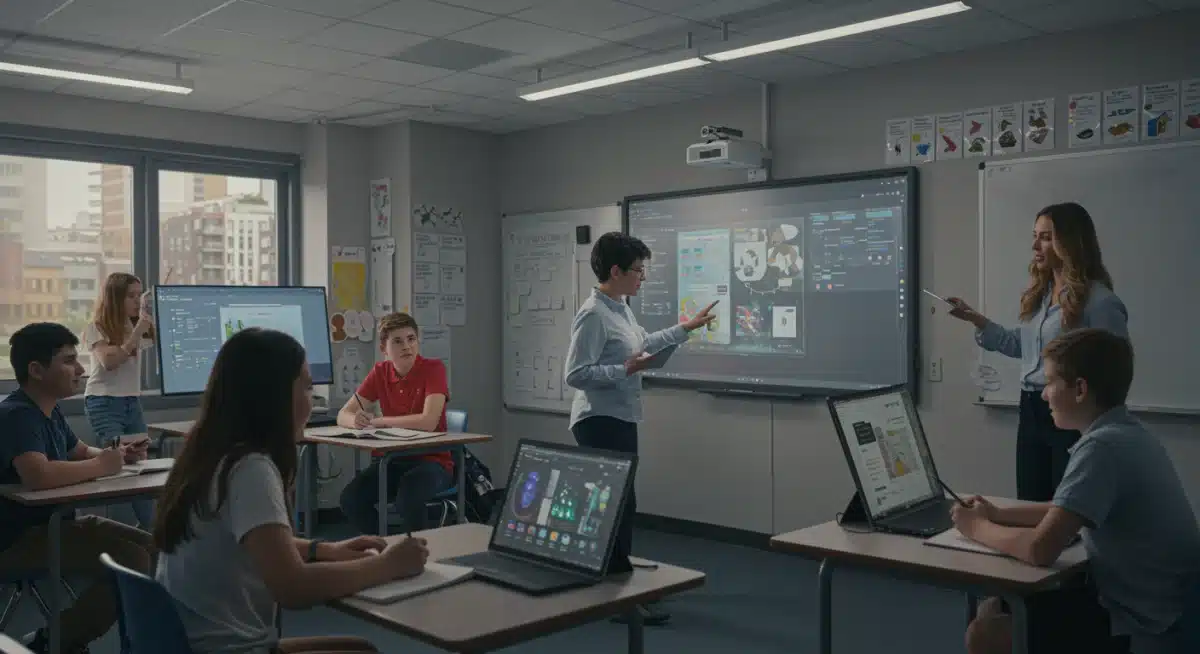
By 2026, artificial intelligence is set to profoundly reshape K-12 education, offering unprecedented opportunities for personalized learning and operational efficiencies, while simultaneously presenting complex challenges related to ethics, equity, and teacher training that demand careful navigation.
As we navigate towards the mid-2020s, the conversation around AI in K-12 classrooms 2026 is no longer speculative but a tangible reality demanding immediate attention. This evolving landscape promises to revolutionize traditional pedagogical approaches, offering both exciting opportunities and formidable challenges for educators, students, and policymakers across the United States. Understanding these dynamics is crucial for shaping an equitable and effective educational future.
The promise of personalized learning with AI
One of the most compelling opportunities presented by AI in K-12 education is its capacity to deliver truly personalized learning experiences. Traditional classrooms often struggle to cater to the diverse learning styles, paces, and needs of individual students. AI-powered platforms are changing this paradigm, adapting content and instructional strategies in real-time to optimize student engagement and comprehension.
These systems leverage sophisticated algorithms to analyze student performance data, identify areas of strength and weakness, and then dynamically adjust the learning path. This means a student struggling with algebra might receive additional interactive tutorials and practice problems, while another excelling in reading might be presented with advanced literary analysis tasks. Such adaptive learning environments can foster greater academic achievement and boost student confidence.
Adaptive learning platforms and their impact
Adaptive learning platforms are at the forefront of AI integration. They are designed to respond to each student’s unique progress, ensuring that instruction is neither too easy nor too difficult. This dynamic adjustment prevents disengagement from boredom or frustration, keeping students optimally challenged.
- Tailored content delivery: AI curates specific materials, videos, and exercises for each student.
- Real-time feedback: Students receive immediate feedback on their work, allowing for instant correction and understanding.
- Progress tracking: Detailed analytics provide teachers with insights into individual and class-wide performance trends.
- Engagement enhancement: Gamified elements and interactive simulations keep students motivated.
The impact extends beyond academic scores. Personalized learning, supported by AI, can cultivate a deeper sense of ownership over one’s education, encouraging self-directed learning and critical thinking skills essential for future success. This shift moves away from a one-size-fits-all model to an education system that truly values individual growth.
In essence, personalized learning through AI holds the potential to unlock every student’s full potential, creating a more inclusive and effective educational landscape. The ability to cater to individual needs on such a large scale represents a significant leap forward in educational technology.
Operational efficiencies and administrative support
Beyond direct student instruction, AI is poised to significantly enhance operational efficiencies and provide invaluable administrative support within K-12 schools. Teachers and administrators often grapple with time-consuming tasks that detract from their core mission of educating students. AI solutions can automate many of these processes, freeing up valuable human resources.
From grading assignments and managing attendance to scheduling and resource allocation, AI tools can streamline workflows and reduce the administrative burden. This allows educators to focus more on instructional planning, student interaction, and professional development, ultimately improving the quality of education delivered.
Automating routine tasks for educators
The automation of routine tasks is perhaps one of the most immediate benefits for teachers. Manual grading, especially for objective assessments, can consume hours of a teacher’s week. AI-powered grading systems can evaluate quizzes, multiple-choice tests, and even provide preliminary feedback on essays, allowing teachers to concentrate on more complex, nuanced grading and personalized student support.
- Automated grading: Efficiently scores objective tests and provides initial feedback on written assignments.
- Attendance tracking: AI systems can accurately monitor student presence, reducing manual record-keeping.
- Curriculum development assistance: AI can suggest relevant resources and activities based on learning objectives.
- Communication support: AI chatbots can handle routine parent inquiries, providing quick answers to common questions.
Moreover, AI can assist in the creation of differentiated learning materials, quickly generating variations of assignments or explanations to suit various student needs. This capability ensures that teachers can provide a more equitable learning experience without significantly increasing their workload. The promise of AI in this context is not to replace educators, but to empower them with tools that enhance their effectiveness and job satisfaction.
By offloading mundane tasks, AI allows educators to reclaim time for high-value interactions, fostering stronger teacher-student relationships and a more dynamic learning environment. This optimization of resources is critical for modern educational institutions facing increasing demands and limited budgets.
Ethical considerations and data privacy in AI education
While the benefits of AI in K-12 classrooms are substantial, the integration of these technologies also introduces a complex array of ethical considerations and challenges related to data privacy. The collection and analysis of vast amounts of student data, while crucial for personalization, raise legitimate concerns about how this sensitive information is protected and used.
Ensuring transparency in data practices, obtaining informed consent, and adhering to strict privacy regulations are paramount. Without robust safeguards, there is a risk of data breaches, misuse of student information, or even algorithmic bias perpetuating existing inequalities within the education system.
Safeguarding student data and ensuring fairness
The privacy of student data is a non-negotiable aspect of AI implementation. Schools must prioritize the security of personal and academic information, implementing strong encryption protocols and access controls. Clear policies regarding data ownership, retention, and sharing must be established and communicated to all stakeholders, including parents and students.
- Robust data encryption: Protecting student data from unauthorized access.
- Transparent data policies: Clearly outlining how data is collected, stored, and used.
- Informed consent: Ensuring parents and students understand and agree to data practices.
- Compliance with regulations: Adhering to laws like FERPA (Family Educational Rights and Privacy Act).
Another critical ethical challenge is algorithmic bias. AI systems learn from data, and if that data reflects societal biases, the AI can inadvertently perpetuate or even amplify them. This could lead to unfair outcomes, such as certain student groups receiving less challenging material or being misidentified as struggling. Developers and educators must work together to audit AI algorithms for bias and ensure equitable treatment for all students.
Moreover, the potential for AI to create a ‘digital divide’ must be addressed. Students from lower socioeconomic backgrounds might lack access to the necessary devices or internet connectivity to fully benefit from AI-powered learning. Ensuring equitable access to technology and support is essential to prevent AI from widening educational disparities. The ethical deployment of AI requires continuous vigilance and a commitment to fairness and privacy.

Teacher training and professional development for AI integration
The successful integration of AI in K-12 classrooms hinges significantly on the preparedness of educators. Teachers are not merely facilitators but active participants in shaping the AI-enhanced learning environment. Therefore, comprehensive teacher training and ongoing professional development are indispensable to equip them with the necessary skills and confidence to leverage AI effectively.
This includes understanding how AI tools work, knowing how to interpret AI-generated data, and critically, how to integrate these tools into their pedagogical practices in a meaningful way. Without adequate training, AI risks becoming an underutilized or even detrimental addition to the classroom.
Empowering educators for the AI era
Professional development programs must move beyond basic technical instruction to cover the pedagogical implications of AI. Teachers need to learn how to use AI to differentiate instruction, provide targeted interventions, and cultivate higher-order thinking skills in students. It’s about understanding AI as a powerful assistant, not a replacement.
- AI literacy workshops: Educating teachers on the fundamentals of AI and its applications in education.
- Pedagogical integration strategies: Training on how to effectively weave AI tools into lesson plans and curriculum.
- Data interpretation skills: Helping teachers understand and act upon insights from AI analytics.
- Ethical AI use: Discussing responsible AI practices, bias detection, and data privacy.
Furthermore, ongoing support and communities of practice are crucial. Teachers need opportunities to share best practices, troubleshoot challenges, and collectively evolve their understanding of AI’s role. This continuous learning model ensures that educators remain at the forefront of educational innovation, adapting to new AI advancements as they emerge.
Investing in teacher training is an investment in the future of education. Empowering educators to confidently and competently use AI will maximize its potential to transform K-12 learning, ensuring that human expertise remains central to the educational process. This human-AI collaboration is key to unlocking the full promise of this technology.
Addressing equity and access in AI-powered education
As AI becomes more prevalent in K-12 classrooms, a significant challenge lies in ensuring equitable access and preventing the technology from exacerbating existing educational disparities. The digital divide, which often correlates with socioeconomic status and geographic location, could widen if access to AI-powered learning tools is not universally provided.
Schools and districts must proactively address issues of infrastructure, device availability, and internet connectivity to ensure that all students, regardless of their background, can benefit from AI’s transformative potential. Ignoring these disparities risks creating a two-tiered education system that further marginalizes vulnerable populations.
Bridging the digital divide with AI
Strategies for bridging the digital divide must be multifaceted. This involves securing funding for devices, ensuring reliable internet access both in school and at home, and providing technical support for families who may be unfamiliar with new technologies. Public-private partnerships can play a crucial role in achieving these goals.
- Device provision programs: Ensuring every student has access to a learning device.
- Broadband initiatives: Expanding internet access to underserved communities.
- Technical support and training: Offering assistance to students and families on using AI tools.
- Curriculum design for accessibility: Developing AI tools that are inclusive for students with disabilities.
Moreover, AI tools themselves need to be designed with equity in mind. This means developing platforms that are accessible to students with diverse learning needs and disabilities, offering multilingual support, and ensuring that content is culturally relevant. The goal should be to leverage AI to level the playing field, not to create new barriers.
Policy decisions at the local, state, and federal levels will be critical in shaping an equitable AI education landscape. Funding allocations, regulatory frameworks, and incentive programs can help ensure that the benefits of AI in K-12 classrooms are distributed fairly across all communities. A concerted effort is required to ensure AI serves as an equalizer, not a divider.
Future outlook: AI’s evolving role beyond 2026
Looking beyond 2026, the role of AI in K-12 classrooms is expected to continue its rapid evolution, moving towards even more sophisticated and integrated applications. We are currently witnessing the foundational stages, but future advancements promise to deepen AI’s impact on every facet of the educational experience, from curriculum design to student assessment and teacher professional growth.
Emerging technologies like advanced natural language processing, predictive analytics, and virtual reality combined with AI will unlock new possibilities for immersive, highly adaptive, and deeply engaging learning environments. This ongoing evolution will necessitate continuous adaptation and foresight from all stakeholders in education.
Emerging AI applications and pedagogical shifts
The next wave of AI applications is likely to include more sophisticated intelligent tutoring systems that can engage in natural language conversations with students, providing personalized explanations and guidance akin to a human tutor. Predictive analytics will become even more refined, allowing for earlier identification of students at risk and more proactive interventions.
- Advanced intelligent tutoring: AI tutors offering highly interactive and conversational support.
- AI-driven curriculum development: AI assisting in creating dynamic, responsive, and relevant learning content.
- Virtual and augmented reality integration: Immersive learning experiences powered by AI for subjects like science and history.
- Personalized career guidance: AI tools helping students explore career paths based on their skills and interests.
Furthermore, AI will play an increasing role in fostering creativity and complex problem-solving skills. By automating rote tasks, AI frees up cognitive space for students to engage in higher-order thinking, collaborative projects, and innovative endeavors. The pedagogical shift will emphasize project-based learning, critical thinking, and the development of skills that complement, rather than compete with, AI capabilities.
The future also holds the potential for AI to support a more globalized and interconnected learning experience, allowing students to collaborate with peers and access educational resources from around the world. The evolving role of AI in K-12 classrooms beyond 2026 is one of continuous innovation, demanding flexible infrastructure, forward-thinking policies, and a commitment to lifelong learning for both students and educators.
| Key Aspect | Brief Description |
|---|---|
| Personalized Learning | AI tailors educational content and pace to individual student needs, enhancing engagement and comprehension. |
| Operational Efficiency | AI automates administrative tasks like grading and attendance, freeing teachers for instructional focus. |
| Ethical Challenges | Concerns over student data privacy, algorithmic bias, and ensuring equitable access to AI tools. |
| Teacher Preparedness | Comprehensive training and professional development are vital for educators to effectively integrate AI into teaching. |
Frequently asked questions about AI in K-12 classrooms (2026)
By 2026, AI will personalize learning by adapting content, pace, and teaching methods to each student’s unique needs and learning style. AI-powered platforms will analyze performance data to offer tailored resources, identify areas for improvement, and provide real-time feedback, fostering more effective and engaging educational journeys for every student.
Key challenges include safeguarding student data privacy, addressing potential algorithmic biases that could perpetuate inequalities, ensuring equitable access to AI tools for all students regardless of socioeconomic status, and providing adequate training and professional development for educators to effectively utilize these new technologies in their classrooms.
Schools must implement robust data encryption, establish transparent data policies, obtain informed consent from parents and students, and strictly comply with privacy regulations like FERPA. Regular audits of AI systems and partnerships with reputable vendors committed to data security are also essential to protect sensitive student information.
No, AI is not expected to replace teachers in K-12 classrooms by 2026. Instead, AI will serve as a powerful assistant, automating administrative tasks, providing personalized learning support, and offering data insights. This allows teachers to focus more on complex instruction, emotional support, and fostering critical thinking, enhancing their role rather than diminishing it.
Teachers will need AI literacy to understand how AI tools function, skills in integrating AI into lesson plans, the ability to interpret AI-generated student data, and a strong understanding of ethical AI use, including bias detection and data privacy. Ongoing professional development will be crucial for adapting to new advancements.
Conclusion
The journey towards a future where AI is seamlessly integrated into K-12 classrooms by 2026 is filled with both immense promise and significant hurdles. The opportunities for personalized learning, enhanced operational efficiency, and innovative pedagogical approaches are transformative. However, realizing these benefits requires a proactive and thoughtful approach to addressing the inherent challenges, particularly concerning data privacy, ethical AI development, equitable access, and comprehensive teacher preparedness. As we move forward, a collaborative effort among educators, policymakers, technology developers, and communities will be vital to harness AI’s full potential, ensuring it serves as a powerful tool to foster an inclusive, effective, and future-ready educational system for all students in the United States.