Future-Proofing Your Child’s Education: A 5-Step Guide to Integrating AI Literacy by 2026
Future-Proofing Your Child’s Education: A 5-Step Guide to Integrating AI Literacy by 2026
The dawn of Artificial Intelligence (AI) is not just a technological shift; it’s a fundamental change in how we live, work, and interact with the world. For our children, who are growing up in this rapidly evolving landscape, understanding AI isn’t just an advantage—it’s a necessity. As parents and educators, our responsibility is to ensure they are not merely consumers of AI but informed, critical, and ethical participants in its development and application. This comprehensive guide outlines a proactive 5-step approach to integrating AI literacy education into your child’s learning journey by 2026, providing practical solutions to future-proof their education.
The year 2026 is not far off, and the pace of AI advancement is accelerating exponentially. The skills that were valuable a decade ago are being redefined, and new competencies are emerging as paramount. AI literacy education is no longer an optional add-on; it’s a core component of a well-rounded education, akin to digital literacy or critical thinking. This article will delve into actionable strategies, resources, and mindsets required to effectively introduce and embed AI concepts, ensuring your child is not just ready for the future but actively shaping it.
Understanding the Imperative: Why AI Literacy Education is Crucial Now
Before we dive into the steps, it’s vital to grasp the profound impact AI will have on every facet of our children’s lives. From future careers to daily decision-making, AI will be an embedded force. Ignoring AI literacy education would be akin to preparing children for a world without computers in the late 20th century. The goal is not to turn every child into an AI engineer, but to empower them with the foundational knowledge and critical thinking skills to navigate an AI-driven society responsibly and effectively.
The Shifting Job Market
Automation and AI are already transforming industries, and this trend will only intensify. Many repetitive tasks will be handled by machines, increasing the demand for roles that require uniquely human skills: creativity, critical thinking, problem-solving, emotional intelligence, and ethical reasoning. However, even these roles will increasingly involve collaboration with AI systems. Therefore, understanding how AI works, its capabilities, and its limitations will be essential for virtually all professions. AI literacy education ensures adaptability.
Ethical Considerations and Societal Impact
AI’s power comes with significant ethical implications. Bias in algorithms, privacy concerns, and the potential for misuse are real challenges that our children will inherit. A robust AI literacy education must include discussions around these ethical dilemmas, fostering a generation that can critically evaluate AI systems, advocate for responsible AI development, and contribute to equitable technological progress. This isn’t just about technology; it’s about citizenship in an AI age.
Empowerment, Not Fear
There’s often a narrative of fear surrounding AI. Our role is to replace that fear with empowerment. By understanding AI, children can move beyond being passive recipients of technology to active creators, innovators, and problem-solvers. They can leverage AI as a tool to amplify their own capabilities, solve complex problems, and contribute meaningfully to their communities. A solid AI literacy education foundation builds confidence and curiosity.
Step 1: Demystifying AI – Foundational Concepts for All Ages
The first step in integrating AI literacy education is to break down complex AI concepts into understandable, age-appropriate components. This isn’t about teaching advanced machine learning to kindergartners, but about building a conceptual framework that grows with them. Start early and make it fun and relatable.
For Younger Children (Ages 4-8): Play-Based Introduction
- What is a ‘Smart’ Machine? Introduce the idea that some machines can ‘learn’ or ‘make decisions’ based on rules we give them. Use examples like smart speakers (Alexa, Google Home) or even simple toy robots that follow commands.
- Pattern Recognition Games: AI thrives on patterns. Engage children in games that involve identifying patterns in shapes, colors, or sounds. This builds an intuitive understanding of how AI might process information.
- Simple Algorithms: Introduce the concept of a sequence of instructions. "If you want to build a tower, first you get a block, then you put it on the bottom, then you get another block…" This is a basic algorithm.
- Cause and Effect: Discuss how actions lead to reactions, a core concept for understanding how AI responds to input.
For Middle Schoolers (Ages 9-13): Exploring AI in Everyday Life
- Identify AI Applications: Help them recognize AI in their daily lives: recommendation engines on streaming services, facial recognition on phones, self-driving cars, spam filters, and even video game NPCs. Discuss how these work at a high level.
- Data Collection and Privacy: Introduce the idea that AI needs data to learn. Discuss what data is, how it’s collected, and the importance of privacy and consent. This is a critical component of AI literacy education.
- Simple AI Simulations/Games: Engage with online games or apps that simulate AI behaviors, such as teaching a virtual pet or guiding a robot through a maze using logical commands.
- Basic Machine Learning Concepts: Explain that AI ‘learns’ from examples. If you show it many pictures of cats, it learns what a cat looks like. Introduce supervised vs. unsupervised learning in simple terms.
For High Schoolers (Ages 14-18): Deeper Dive into Concepts and Impact
- Neural Networks and Deep Learning: Provide a conceptual understanding of how neural networks mimic the human brain to process information, without getting lost in the mathematics.
- Ethical AI and Bias: This is where critical discussions become paramount. Explore case studies of AI bias (e.g., in facial recognition or hiring algorithms) and discuss the societal implications.
- AI’s Role in Specific Fields: Connect AI to subjects they are already studying: AI in medicine, climate science, art, literature, etc. Show them how AI literacy education opens doors to diverse career paths.
- Introduction to AI Programming Logic: Even without deep coding, introduce pseudo-code or visual programming tools that demonstrate AI logic (e.g., "if-then-else" statements, loops).
Step 2: Hands-On Exploration – Practical Engagement with AI Tools
Understanding concepts is one thing; experiencing them is another. Practical engagement is crucial for deep AI literacy education. Provide opportunities for children to interact with, experiment with, and even create simple AI systems.
Coding and Visual Programming Platforms
Many platforms make AI accessible without requiring extensive coding knowledge:
- Scratch (MIT Media Lab): While not exclusively AI, Scratch helps build computational thinking, sequencing, and logical reasoning—foundational skills for AI. There are also Scratch extensions that allow for machine learning projects.
- Teachable Machine (Google): This incredible tool allows anyone to train a machine learning model using images, sounds, or poses, without writing any code. Children can train a model to recognize their hand gestures or different objects. It’s a fantastic entry point for AI literacy education.
- Cognimates (MIT Media Lab): An extension of Scratch that allows children to build AI projects like training a robot to avoid obstacles or creating an intelligent chatbot.
- Code.org: Offers various courses, some of which introduce AI concepts through interactive puzzles and block-based coding.

Robotics and Smart Devices
Interacting with physical AI can be incredibly engaging:
- Programmable Robots: Robots like LEGO Mindstorms, Sphero, or Ozobot can be programmed to perform tasks, react to their environment, and even learn simple behaviors.
- DIY AI Projects: For older children, projects involving Raspberry Pi or Arduino with simple AI modules (like object detection or voice recognition) can be highly rewarding.
- Smart Home Devices: Explore how smart speakers and other IoT devices work. Discuss how they process voice commands, learn preferences, and interact with other systems. This provides a tangible context for AI literacy education.
Data Science Basics
AI is fueled by data. Introducing basic data concepts is essential:
- Data Collection and Organization: Engage children in collecting simple data (e.g., types of birds seen in the garden, favorite colors of classmates) and organizing it in charts or graphs.
- Data Interpretation: Discuss what patterns and insights can be drawn from the collected data. This lays the groundwork for understanding how AI makes predictions or classifications.
Step 3: Cultivating Critical Thinking and Ethical Awareness
Beyond technical skills, AI literacy education must foster critical thinking and a strong ethical compass. This ensures children can navigate the complexities of AI responsibly.
Questioning AI: The "Why" and "How"
- Deconstruct AI Recommendations: When a streaming service suggests a show, ask: "Why do you think the AI recommended this? What information might it be using?"
- Identify AI Limitations: Discuss instances where AI fails or makes mistakes. This helps children understand that AI is not infallible and has boundaries. For example, why might a self-driving car struggle in heavy snow?
- Spotting AI Manipulation: As deepfakes and AI-generated content become more prevalent, teach children to question the authenticity of digital media. Discuss how AI can be used to create misleading information. This is a crucial aspect of AI literacy education in the digital age.
Ethical Dilemmas and Discussions
Introduce age-appropriate scenarios that prompt ethical discussions:
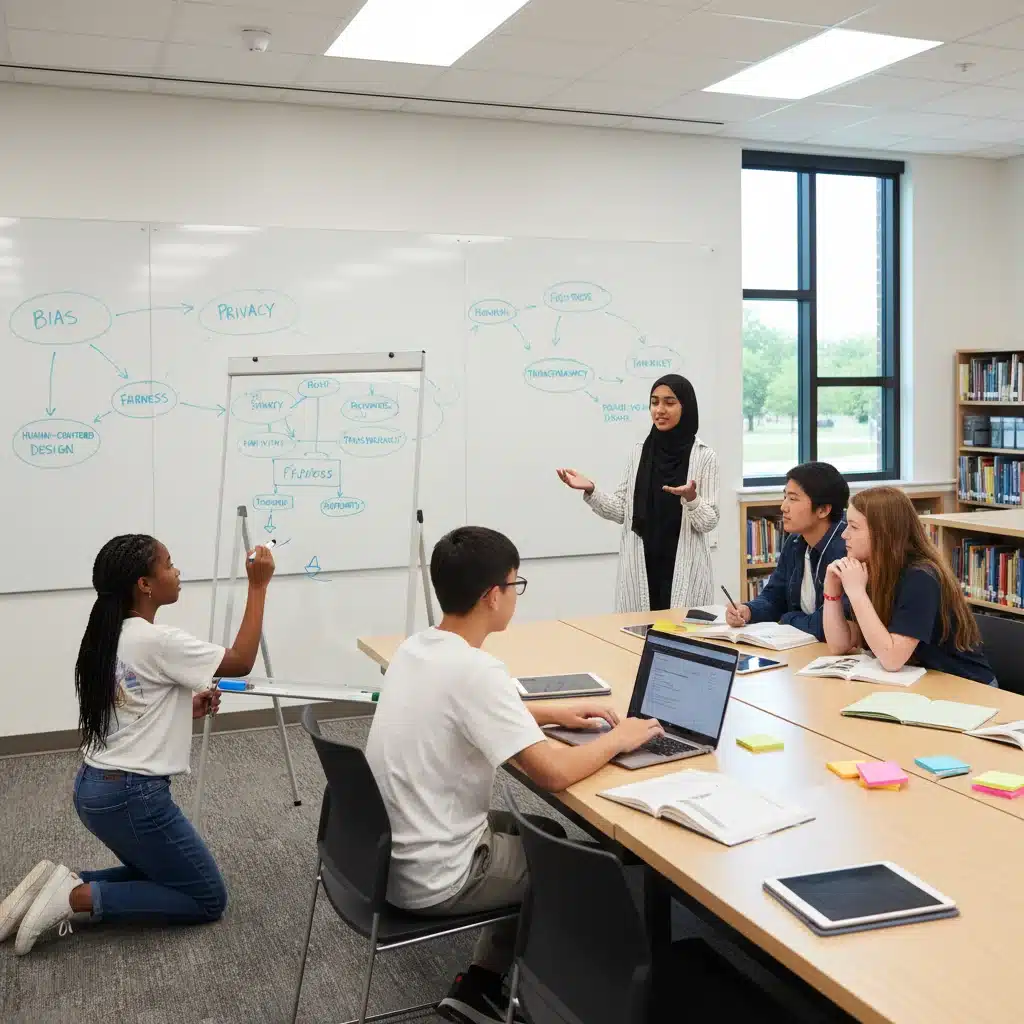
- Bias in AI: Use examples of AI systems showing bias (e.g., a hand soap dispenser not recognizing darker skin tones). Discuss why this happens and its impact.
- Privacy vs. Convenience: Explore the trade-offs. "Is it okay for an AI to track your location if it helps you find your lost phone? What are the benefits and risks?"
- Fairness and Equity: Discuss how AI decisions can affect different groups of people. "If an AI decides who gets a loan, how can we ensure it’s fair to everyone?"
- The Future of Work: Engage in discussions about how AI might change jobs and what new skills will be needed.
Media Literacy in an AI World
Extend traditional media literacy to include AI:
- Source Evaluation: Teach children to critically evaluate sources of information, especially when AI-generated content becomes indistinguishable from human-created content.
- Understanding Algorithms: Explain that social media feeds and search results are curated by algorithms. Discuss how these algorithms can create "filter bubbles" and influence opinions. This deepens their AI literacy education.
Step 4: Integrating AI Literacy into Existing Curricula and Home Life
For AI literacy education to be effective, it cannot exist in a vacuum. It needs to be woven into the fabric of daily learning, both at school and at home.
At School: A Cross-Curricular Approach
- Science and Technology: This is the most obvious fit. Integrate AI concepts into computer science classes, robotics clubs, and science projects.
- Mathematics: Discuss how AI uses statistics, probability, and algebra. Data analysis projects can easily incorporate AI-related concepts.
- Social Studies/History: Explore the history of automation and computing, and discuss the societal impact of past technological revolutions to contextualize AI’s current and future impact.
- Language Arts/Humanities: Discuss AI in literature (e.g., science fiction), explore the ethics of AI through debates and essays, and analyze AI-generated creative works.
- Arts: Experiment with AI art generators, discuss AI’s role in music composition, or design interfaces for AI applications.
At Home: Everyday Learning Opportunities
- Tech Talk at Dinner: Regularly discuss AI news, new technologies, and ethical questions as a family.
- Documentaries and Books: Watch age-appropriate documentaries about AI or read books (fiction and non-fiction) that explore AI themes.
- Educational Apps and Games: Utilize apps and games designed to teach coding, logic, and AI concepts.
- Family Projects: Work together on simple AI projects using tools like Teachable Machine or Scratch.
- Visiting Science Museums: Many museums now have exhibits dedicated to AI and robotics, offering interactive learning experiences.
Step 5: Fostering a Growth Mindset and Lifelong Learning
The field of AI is constantly evolving. The most important lesson we can impart through AI literacy education is the importance of a growth mindset and a commitment to lifelong learning. The specific tools and techniques learned today may be obsolete tomorrow, but the underlying principles and the ability to adapt will remain invaluable.
Embrace Curiosity and Experimentation
- Encourage Questions: Foster an environment where asking "how does that work?" and "what if?" is celebrated.
- Learning from Failure: AI development often involves trial and error. Teach children that mistakes are part of the learning process and opportunities for improvement.
- Explore New Technologies: Encourage them to explore new AI tools and applications as they emerge, fostering a sense of continuous discovery.
Mentorship and Community
- Connect with Experts: If possible, expose children to professionals working in AI through virtual talks, workshops, or career days.
- Join Clubs and Competitions: Robotics clubs, coding competitions, and AI challenges can provide a stimulating environment for learning and collaboration.
- Online Learning Communities: For older children, guide them towards reputable online courses and communities where they can continue to deepen their knowledge and connect with peers. These platforms are excellent for ongoing AI literacy education.
Developing "Human" Skills
While AI will handle many analytical and computational tasks, uniquely human skills will become even more prized:
- Creativity and Innovation: AI can assist creativity, but human imagination remains the driving force.
- Critical Thinking and Problem Solving: The ability to frame problems, evaluate solutions, and make nuanced judgments.
- Communication and Collaboration: Working effectively with others, including AI systems.
- Emotional Intelligence and Empathy: Understanding human needs and motivations to design and apply AI responsibly.
- Adaptability and Resilience: The capacity to thrive in a constantly changing technological landscape.
Challenges and Considerations in Implementing AI Literacy Education
While the benefits of AI literacy education are clear, implementing it effectively also presents challenges. Addressing these proactively will be key to success.
Teacher Training and Resources
Many educators may not have a background in AI. Comprehensive professional development programs are essential to equip teachers with the knowledge and confidence to integrate AI concepts into their lessons. This includes providing access to age-appropriate curricula, tools, and ongoing support. Schools need to invest in these resources to make AI literacy education a reality.
Equitable Access to Technology
The digital divide remains a significant concern. Ensuring all children, regardless of socioeconomic background, have access to the necessary technology (computers, internet, AI tools) is paramount. Initiatives like providing devices, community learning centers, and affordable internet access are critical to prevent a new form of inequality based on AI literacy.
Staying Current with Rapid Advancements
AI is a fast-moving field. Curricula and resources need to be flexible and regularly updated to reflect new developments. This requires ongoing research, collaboration between educators and AI experts, and a commitment to continuous improvement in AI literacy education programs.
Balancing Screen Time and Holistic Development
While AI education often involves screens, it’s important to balance this with other forms of learning and play. Hands-on activities, outdoor exploration, and social interaction remain vital for holistic child development. AI literacy education should complement, not replace, these essential experiences.
The Path Forward: A Call to Action for 2026
The integration of AI literacy education into our children’s learning journey by 2026 is an ambitious but achievable goal. It requires a concerted effort from parents, educators, policymakers, and technology providers. By following these 5 steps, we can ensure our children are not just prepared for the future, but are empowered to shape it with wisdom, creativity, and a strong ethical foundation.
Let’s move beyond simply teaching them to use AI, and instead, teach them to understand it, question it, and build it responsibly. The future is AI-driven, and equipping our children with AI literacy education is the most profound gift we can give them for success and fulfillment in the decades to come. The time to act is now, to build a generation of AI-literate citizens who can harness this powerful technology for the greater good.