Federal Child Tax Credit 2026: Understanding the Latest $3,600 Per Child Benefits

Federal Child Tax Credit 2026: Understanding the Latest $3,600 Per Child Benefits
The landscape of family financial support in the United States is constantly evolving, with the Federal Child Tax Credit (CTC) being a cornerstone of assistance for millions of households. As we look towards 2026, there’s significant anticipation and discussion surrounding potential changes to this vital credit, particularly the possibility of a $3,600 per child benefit. Understanding the nuances of the Child Tax Credit 2026 is crucial for families planning their financial futures and maximizing their eligibility for these essential funds.
The Child Tax Credit has historically played a significant role in reducing child poverty and providing financial relief to families. Its structure and benefit amounts have varied over time, notably with the expanded benefits seen during the pandemic. As those expansions have largely receded, policymakers and advocacy groups are pushing for new legislation to reinstate or even enhance previous levels of support. This article will delve deep into what families can expect from the Federal Child Tax Credit 2026, exploring the potential $3,600 per child benefits, eligibility requirements, the legislative outlook, and how these changes could impact your household’s bottom line.
The Evolution of the Child Tax Credit: A Historical Perspective
To fully grasp the potential impact of the Child Tax Credit 2026, it’s helpful to understand its journey. Introduced in 1997, the CTC began as a modest $500 non-refundable credit per child. Over the years, it has undergone several significant transformations, most notably with the Tax Cuts and Jobs Act (TCJA) of 2017 and the American Rescue Plan Act (ARPA) of 2021.
Key Milestones:
- 1997: Established at $500 per child.
- 2001-2010s: Gradually increased and made partially refundable.
- 2017 (TCJA): Increased to $2,000 per child, with up to $1,400 being refundable. It also raised income thresholds significantly, making more higher-income families eligible.
- 2021 (ARPA): This was a landmark year for the CTC. It temporarily increased the credit to $3,600 per child under age 6 and $3,000 per child aged 6-17. Crucially, it made the credit fully refundable, meaning even families with little to no income could receive the full amount. It also introduced advance monthly payments, providing immediate financial relief.
The expanded benefits under ARPA expired at the end of 2021, reverting the credit largely to its TCJA parameters. This reversion sparked widespread calls for a permanent expansion, recognizing the profound positive impact the enhanced credit had on child poverty rates and family well-being. The discussions around the Child Tax Credit 2026 are deeply rooted in the desire to recapture those benefits.
What to Expect: The $3,600 Per Child Benefit for 2026
The prospect of a $3,600 per child benefit for the Child Tax Credit 2026 is a central point of current legislative debate. This figure mirrors the enhanced benefit level provided for young children under the American Rescue Plan Act. While no legislation has been finalized, the push for this amount stems from several factors:
- Inflationary Pressures: The rising cost of living, including childcare, food, and housing, has put immense pressure on family budgets. A higher CTC would offer much-needed relief.
- Poverty Reduction: Studies have shown that the expanded CTC significantly reduced child poverty. Advocates argue that reinstating a similar level of support is essential for child well-being.
- Economic Stimulus: Providing direct financial aid to families can stimulate local economies as families spend the funds on essential goods and services.
It’s important to differentiate between a refundable and a non-refundable credit. A non-refundable credit can reduce your tax liability to zero, but you won’t receive any remaining credit back as a refund. A fully refundable credit, like the ARPA’s version, means that if the credit amount exceeds your tax liability, you receive the difference as a tax refund. The proposed $3,600 benefit for the Child Tax Credit 2026 is often discussed in the context of being fully refundable, which is critical for low-income families.
Eligibility Criteria for the Child Tax Credit 2026
While the exact parameters for the Child Tax Credit 2026 will depend on future legislation, we can anticipate that several core eligibility requirements will remain consistent, potentially with adjustments to income thresholds and age limits. Here’s a breakdown of what families typically need to meet:
Qualifying Child Requirements:
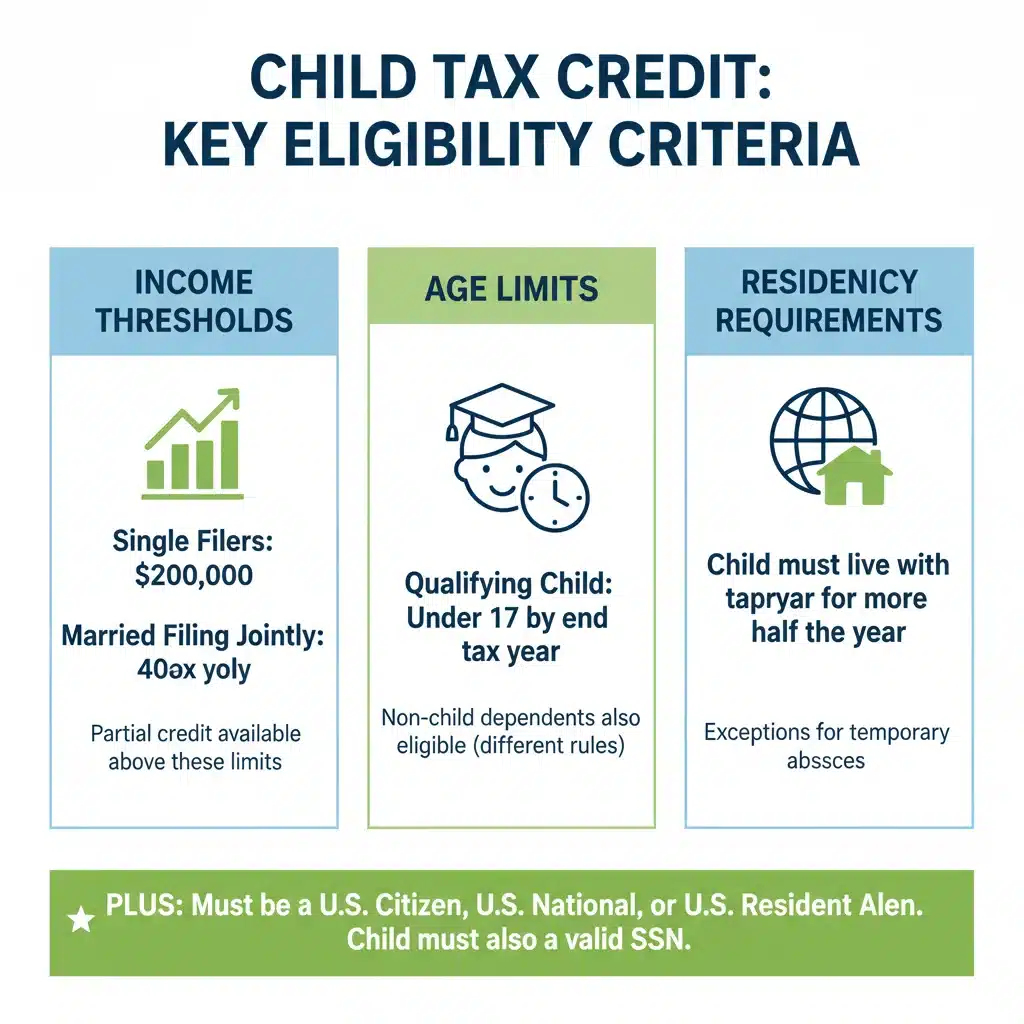
- Age: The child must be under the age of 17 at the end of the tax year. Discussions around the 2026 credit often include expanding this to age 17 or even 18, or providing a higher benefit for younger children (e.g., under 6).
- Relationship: The child must be your son, daughter, stepchild, foster child, brother, sister, half-brother, half-sister, stepbrother, stepsister, or a descendant of any of them (e.g., a grandchild, niece, or nephew).
- Residency: The child must have lived with you for more than half of the tax year.
- Support: The child must not have provided more than half of their own support for the year.
- Citizenship: The child must be a U.S. citizen, U.S. national, or U.S. resident alien.
Income Requirements:
Income thresholds are a critical aspect of CTC eligibility. Under the TCJA, the credit begins to phase out for single filers with a Modified Adjusted Gross Income (MAGI) over $200,000 and for married couples filing jointly with a MAGI over $400,000. These high thresholds mean many middle and upper-middle-income families qualify for the full credit.
If the Child Tax Credit 2026 is expanded to $3,600 and made fully refundable, there might be a different set of income thresholds or phase-out rules, particularly for the refundable portion, to ensure it targets low and moderate-income families most effectively. It’s common for refundable portions of credits to have lower income phase-out ranges to concentrate benefits where they are most needed.
The Legislative Outlook for Child Tax Credit 2026
The path to a $3,600 per child benefit for the Child Tax Credit 2026 is paved with political negotiations and legislative maneuvering. There is bipartisan interest in the CTC, but significant differences exist regarding its structure, cost, and target beneficiaries.
Key Areas of Debate:
- Refundability: Democrats generally advocate for a fully refundable credit to ensure all low-income families benefit, even those with no federal income tax liability. Republicans often prefer a less refundable or non-refundable credit, emphasizing work requirements and focusing on tax relief for working families.
- Benefit Amount and Age: While $3,600 is a target, other proposals might suggest different amounts or tiered benefits based on a child’s age (e.g., higher for younger children).
- Income Thresholds: The income levels at which the credit begins to phase out are always a point of contention, balancing broad appeal with targeted assistance.
- Work Requirements: Some proposals link eligibility for the refundable portion of the credit to work or earnings requirements, a point of divergence between parties.
As 2026 approaches, pressure will mount on Congress to address the future of the CTC. The expiration of several provisions from the Tax Cuts and Jobs Act at the end of 2025 will likely open a window for broader tax reform discussions, making it a prime opportunity for changes to the Child Tax Credit 2026. Families should pay close attention to legislative developments throughout 2024 and 2025.
Impact on Families: What a $3,600 CTC Could Mean
If the Child Tax Credit 2026 is indeed set at $3,600 per child and made fully refundable, the impact on American families would be substantial:
- Reduced Child Poverty: The most significant effect would be a dramatic reduction in child poverty, mirroring the success of the ARPA expansion. More families would have the resources to meet basic needs.
- Increased Financial Stability: For many households, an additional $3,600 per child could mean the difference between struggling to make ends meet and achieving a greater sense of financial security. This could help cover childcare costs, educational expenses, healthcare, or simply put food on the table.
- Economic Growth: Direct payments to families often translate into increased consumer spending, providing a boost to local and national economies.
- Improved Child Well-being: Access to more resources can lead to better health outcomes, improved educational attainment, and overall enhanced well-being for children.
- Simplified Tax Filing (Potentially): If advance payments are reinstated, it could provide a steady stream of income for families, reducing the need for emergency loans or other high-interest financial solutions.
Understanding these potential benefits allows families to advocate for policies that support their financial health and prepare for how they might utilize such a significant credit. The discussion around the Child Tax Credit 2026 is not just about numbers; it’s about investing in the future of American children and families.
Planning for the Future: Maximizing Your Child Tax Credit 2026
While the exact details of the Child Tax Credit 2026 are still being debated, families can take proactive steps to ensure they are prepared to claim any available benefits. Financial planning is key, regardless of the legislative outcome.
Steps to Consider:
- Stay Informed: Regularly check reliable sources like the IRS website, reputable financial news outlets, and government policy trackers for updates on CTC legislation.
- Maintain Accurate Records: Keep meticulous records of your children’s Social Security numbers, dates of birth, and residency. This information is crucial for claiming the credit.
- Understand Your Income: Be aware of your Modified Adjusted Gross Income (MAGI), as this will be a primary factor in determining your eligibility and the amount of credit you receive.
- Consult a Tax Professional: A qualified tax advisor can provide personalized guidance, help you understand complex eligibility rules, and ensure you claim all credits for which you are eligible. They can also help you project your potential credit based on current legislative proposals.
- Adjust Withholding (if applicable): If advance payments are reintroduced, you may have the option to adjust your tax withholding to account for these payments, or opt out if you prefer a larger refund at tax time.
- Review Other Credits: The CTC is just one of many tax credits available to families. Explore other credits like the Earned Income Tax Credit (EITC) or the Credit for Child and Dependent Care Expenses to maximize your overall tax benefits.

Proactive planning ensures that when the final details of the Child Tax Credit 2026 are solidified, your family is ready to benefit fully. Don’t wait until tax season to start thinking about these important financial opportunities.
Common Misconceptions About the Child Tax Credit
The Child Tax Credit, especially with its past and potential future changes, can be a source of confusion. Addressing common misconceptions is vital for families to accurately understand their entitlements.
Myth vs. Reality:
- Myth: The CTC is only for low-income families.
Reality: While it significantly benefits low-income families, the current TCJA structure allows many middle and even upper-middle-income families to qualify for a substantial credit. The ARPA expansion made it fully refundable, extending benefits to even the lowest-income households. The Child Tax Credit 2026 debate often centers on how broadly the credit should apply across income levels. - Myth: You automatically receive the credit.
Reality: You must file a federal income tax return to claim the CTC, even if you don’t typically need to file because your income is below the filing threshold. This is especially true for the refundable portion. - Myth: All children qualify regardless of age.
Reality: Under current law, children must be under 17 at the end of the tax year. Proposals for the Child Tax Credit 2026 might adjust this age limit. - Myth: The credit is the same amount for every child.
Reality: While currently $2,000 per child, the ARPA temporarily introduced tiered benefits ($3,600 for under 6, $3,000 for 6-17). Future legislation for the Child Tax Credit 2026 could reintroduce similar age-based distinctions. - Myth: You can claim the credit for a child who doesn’t live with you.
Reality: The qualifying child must generally live with you for more than half the year. There are exceptions for divorced or separated parents, but specific rules apply.
Dispelling these myths helps ensure families don’t miss out on valuable benefits from the Child Tax Credit 2026 or any other tax year.
Beyond 2026: The Long-Term Future of the Child Tax Credit
While our focus is on the Child Tax Credit 2026, it’s important to consider the long-term trajectory of this critical family benefit. The debate surrounding the CTC is part of a larger conversation about social safety nets, economic equity, and the role of government in supporting families.
Many advocates believe that a robust, fully refundable Child Tax Credit should be a permanent fixture of the U.S. tax code, citing its proven effectiveness in combating child poverty and stimulating local economies. However, concerns about the cost of such a program and its potential impact on work incentives are frequently raised by opponents.
The expiration of key provisions from the 2017 Tax Cuts and Jobs Act at the end of 2025 provides a unique legislative opportunity. Congress will likely engage in comprehensive tax reform discussions leading up to and during 2025, which will inevitably include the Child Tax Credit 2026. The outcome will depend heavily on the political climate, economic conditions, and the priorities of the administration and Congress at that time.
Families should continue to engage with their elected officials, share their stories, and stay informed about policy proposals. Public support and advocacy can significantly influence the legislative process and shape the future of the Child Tax Credit for years to come.
Conclusion: Preparing for the Federal Child Tax Credit 2026
The Federal Child Tax Credit 2026 holds the potential to be a transformative financial benefit for millions of American families, particularly if the proposed $3,600 per child benefit with full refundability comes to fruition. While legislative details are still being hammered out, the discussions underscore a national recognition of the need to support children and ease the financial burdens on parents.
For families, the key is to remain vigilant and proactive. Staying informed about legislative developments, understanding the evolving eligibility criteria, and meticulously preparing your financial records will ensure you are well-positioned to leverage any benefits offered by the Child Tax Credit 2026. Whether it’s through direct advance payments or a significant refund at tax time, a robust CTC can provide crucial support for childcare, education, and overall family well-being.
As we move closer to 2026, the debate will intensify, and the final shape of the Child Tax Credit will emerge. By understanding its history, potential future, and how to navigate its requirements, families can confidently plan for a more financially secure future, supported by this vital federal program.