Mastering Agile Project Management: Strategies for Success

In today’s fast-paced business environment, project management has evolved significantly. Traditional waterfall methodologies, with their linear and rigid structures, often struggle to keep up with rapidly changing requirements and market demands. This is where agile project management steps in, offering a flexible, iterative, and highly collaborative approach that prioritizes adaptability and continuous delivery of value. If you’re looking to enhance your project success rates, improve team morale, and deliver exceptional results, understanding and implementing agile project management is no longer optional – it’s essential.
This comprehensive guide will delve deep into the world of agile project management, exploring its core principles, popular methodologies like Scrum and Kanban, and practical strategies to help you successfully adopt and thrive in an agile environment. We’ll cover everything from building high-performing agile teams to measuring success and overcoming common challenges. By the end of this article, you’ll have a robust understanding of how to leverage agile principles to drive efficiency, innovation, and stakeholder satisfaction in your projects.
What is Agile Project Management? The Fundamentals Explained
At its heart, agile project management is an iterative approach to delivering projects in small, incremental phases. Unlike traditional methods that aim to deliver a complete product at the end of a long development cycle, agile focuses on delivering working software or components frequently. This allows for continuous feedback, adaptation, and improvement throughout the project lifecycle. The philosophy of agile is rooted in the Agile Manifesto, a document created in 2001 by seventeen software developers, which outlines four core values and twelve supporting principles.
The Four Core Values of the Agile Manifesto:
- Individuals and Interactions over Processes and Tools: While processes and tools are important, agile emphasizes the power of human collaboration and communication. Effective teamwork and open dialogue are crucial for problem-solving and innovation.
- Working Software over Comprehensive Documentation: The primary measure of progress in agile is working software (or a functional product increment), not extensive documentation. While documentation has its place, it should serve to support the product, not hinder its development.
- Customer Collaboration over Contract Negotiation: Agile values continuous engagement with the customer. Rather than rigid contracts, agile teams seek ongoing collaboration to ensure the delivered product truly meets the customer’s evolving needs.
- Responding to Change over Following a Plan: Agile embraces change. It acknowledges that requirements can shift, and market conditions can evolve. Instead of sticking to a fixed plan, agile teams are designed to adapt quickly to new information and priorities.
The Twelve Principles of Agile Project Management:
Beyond the core values, the Agile Manifesto outlines twelve principles that guide agile practices:
- Our highest priority is to satisfy the customer through early and continuous delivery of valuable software.
- Welcome changing requirements, even late in development. Agile processes harness change for the customer’s competitive advantage.
- Deliver working software frequently, from a couple of weeks to a couple of months, with a preference to the shorter timescale.
- Business people and developers must work together daily throughout the project.
- Build projects around motivated individuals. Give them the environment and support they need, and trust them to get the job done.
- The most efficient and effective method of conveying information to and within a development team is face-to-face conversation.
- Working software is the primary measure of progress.
- Agile processes promote sustainable development. The sponsors, developers, and users should be able to maintain a constant pace indefinitely.
- Continuous attention to technical excellence and good design enhances agility.
- Simplicity – the art of maximizing the amount of work not done – is essential.
- The best architectures, requirements, and designs emerge from self-organizing teams.
- At regular intervals, the team reflects on how to become more effective, then tunes and adjusts its behavior accordingly.
These principles form the bedrock of agile project management, guiding teams to be more responsive, efficient, and customer-centric.
Popular Agile Methodologies: Scrum and Kanban
While agile is a philosophy, several methodologies provide frameworks for implementing agile principles in practice. The two most widely adopted are Scrum and Kanban.
Scrum: The Iterative Framework for Complex Projects
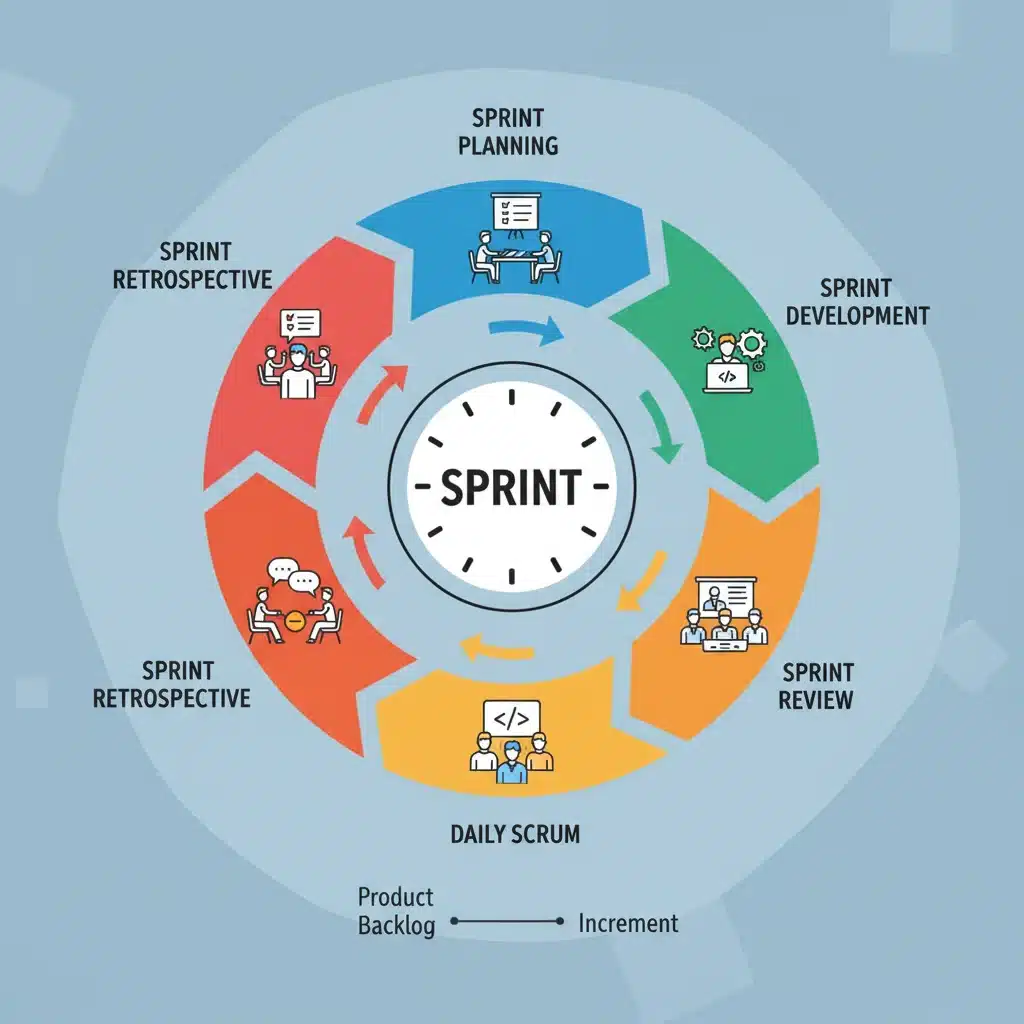
Scrum is an iterative, incremental framework for developing, delivering, and sustaining complex products. It’s highly prescriptive, defining specific roles, events, and artifacts. The core of Scrum revolves around "sprints," which are fixed-length iterations (typically 1-4 weeks) during which a "Done," useable, and potentially releasable product increment is created.
Key Components of Scrum:
- Roles:
- Product Owner: Responsible for maximizing the value of the product resulting from the work of the Development Team. Manages the Product Backlog.
- Scrum Master: Facilitates the Scrum process, removes impediments, and coaches the team on Scrum practices.
- Development Team: A self-organizing and cross-functional group responsible for delivering a "Done" increment at the end of each sprint.
- Events:
- Sprint Planning: The team plans the work to be performed in the upcoming sprint.
- Daily Scrum (Stand-up): A short, daily meeting for the Development Team to synchronize activities and plan for the next 24 hours.
- Sprint Review: The team presents the "Done" increment to stakeholders and gathers feedback.
- Sprint Retrospective: The team inspects itself and creates a plan for improvements to be enacted during the next sprint.
- Artifacts:
- Product Backlog: An ordered list of everything that might be needed in the product.
- Sprint Backlog: The set of Product Backlog items selected for the sprint, plus the plan for delivering them.
- Increment: The sum of all the Product Backlog items completed during a sprint and all previous sprints.
Scrum’s structured yet flexible approach makes it ideal for projects with evolving requirements and a need for rapid feedback loops. Implementing agile project management through Scrum requires commitment to its ceremonies and a cultural shift towards self-organization and transparency.
Kanban: Visualizing Workflow and Limiting Work in Progress
Kanban, originating from Toyota’s production system, is another powerful agile project management methodology focused on visualizing work, limiting work in progress (WIP), and maximizing efficiency. Unlike Scrum’s time-boxed sprints, Kanban is a continuous flow system.
Core Principles of Kanban:
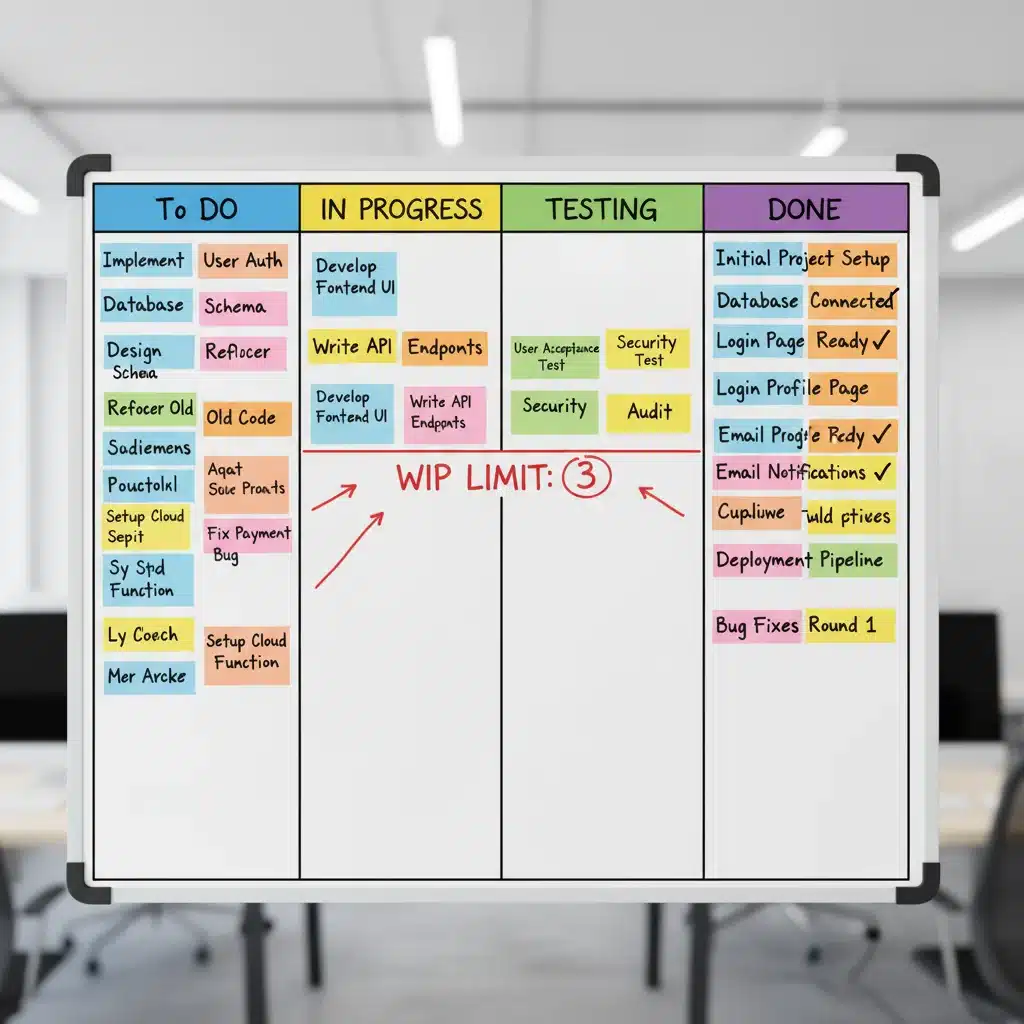
- Visualize Workflow: Use a Kanban board to visualize all work items and their current status. Columns typically represent different stages of the workflow (e.g., To Do, In Progress, Testing, Done).
- Limit Work in Progress (WIP): Set explicit limits on the number of items that can be in progress at each stage. This helps prevent bottlenecks, reduces context switching, and encourages focus.
- Manage Flow: Continuously monitor and improve the flow of work through the system. Identify and address any blockages.
- Make Process Policies Explicit: Clearly define the rules and criteria for moving items from one stage to the next.
- Implement Feedback Loops: Regularly review the process to identify areas for improvement and adapt accordingly.
- Improve Collaboratively, Evolve Experimentally: Encourage continuous improvement based on data and team collaboration.
Kanban is highly adaptable and can be applied to almost any type of project or process. It’s particularly effective for maintenance projects, operational teams, or situations where continuous delivery and flexibility are paramount. The visual nature of Kanban boards provides immediate insight into the project’s status and helps identify areas for optimization, making it a powerful tool in agile project management.
Key Benefits of Embracing Agile Project Management
Adopting agile project management brings a multitude of advantages that can significantly impact project success and organizational effectiveness:
- Increased Flexibility and Adaptability: Agile’s iterative nature allows teams to respond quickly to changes in requirements, market conditions, or customer feedback, reducing the risk of delivering an outdated or irrelevant product.
- Faster Time to Market: By delivering working increments frequently, agile enables organizations to get valuable features into the hands of users sooner, allowing for early feedback and competitive advantage.
- Improved Customer Satisfaction: Continuous customer involvement and feedback loops ensure that the final product truly meets their needs and expectations, leading to higher satisfaction.
- Enhanced Team Collaboration and Morale: Agile fosters a highly collaborative environment where teams are self-organizing and empowered. This often leads to increased ownership, motivation, and a stronger sense of shared purpose.
- Higher Quality Products: The iterative testing and continuous integration inherent in agile methodologies help identify and address defects early, resulting in a more robust and higher-quality final product.
- Reduced Risk: By breaking down large projects into smaller, manageable chunks, agile reduces the overall project risk. Potential issues are identified and mitigated earlier in the development cycle.
- Greater Transparency: Agile practices, especially through the use of visual tools like Kanban boards and regular communication, provide greater visibility into project progress and potential roadblocks for all stakeholders.
These benefits highlight why so many organizations are transitioning to agile project management to stay competitive and deliver value efficiently.
Implementing Agile Project Management: Best Practices and Strategies
Successfully implementing agile project management goes beyond simply adopting a framework; it requires a cultural shift and a commitment to continuous improvement. Here are some best practices and strategies to guide your journey:
1. Build a Strong Agile Team
The success of any agile project hinges on its team. Focus on:
- Cross-functionality: Ensure your team has all the necessary skills (development, testing, design, etc.) to complete a product increment independently.
- Self-organization: Empower teams to decide how best to accomplish their work rather than being micro-managed.
- Collocation (or effective virtual collaboration): While not always possible, physical proximity enhances communication. For remote teams, invest in robust collaboration tools and clear communication protocols.
- Stable Teams: Keep teams together for extended periods to foster trust, improve communication, and enhance productivity.
2. Prioritize Relentlessly with a Clear Product Backlog
A well-maintained and prioritized Product Backlog is crucial. The Product Owner must work closely with stakeholders to define, refine, and order backlog items based on business value, risk, and dependencies. This ensures the team is always working on the most important features first.
3. Embrace Iterative Development and Frequent Feedback
Break down large features into smaller, manageable user stories that can be completed within a single sprint (in Scrum). Deliver working software frequently and actively seek feedback from users and stakeholders. This early and continuous feedback loop is a cornerstone of effective agile project management.
4. Foster Transparency and Open Communication
Agile thrives on transparency. Use visual management tools (like physical or digital Kanban/Scrum boards) to make work visible to everyone. Encourage open and honest communication within the team and with stakeholders. Daily stand-ups are excellent for this.
5. Continuous Improvement through Retrospectives
Regular retrospectives are vital for learning and adaptation. After each sprint or iteration, the team should reflect on what went well, what could be improved, and what specific actions they will take to enhance their process in the next cycle. This commitment to continuous improvement is a hallmark of successful agile project management.
6. Invest in the Right Tools
While individuals and interactions are paramount, effective tools can significantly support agile project management. Consider tools for:
- Backlog Management: Jira, Asana, Trello, Monday.com
- Communication: Slack, Microsoft Teams
- Version Control: Git, GitHub, GitLab
- Continuous Integration/Deployment: Jenkins, GitLab CI/CD
Choosing the right tools can streamline workflows and enhance team productivity.
Common Challenges in Agile Adoption and How to Overcome Them
While the benefits of agile project management are compelling, organizations often face challenges during its adoption. Recognizing these hurdles and planning for them can significantly improve your chances of success.
1. Resistance to Change
People are naturally resistant to change, especially when it involves new ways of working and thinking. This can come from team members, management, or even stakeholders accustomed to traditional methods.
- Solution: Start with small pilot projects. Provide thorough training and coaching on agile principles and practices. Communicate the ‘why’ behind the change and highlight the benefits for individuals and the organization. Secure strong leadership buy-in and sponsorship.
2. Lack of Understanding or Misapplication of Agile Principles
Some organizations adopt agile terminology and ceremonies without truly understanding the underlying principles, leading to "Scrum-but" or "Agile-in-name-only" situations.
- Solution: Invest in certified agile coaches and trainers. Encourage continuous learning and knowledge sharing within the team. Regularly review and reflect on how well the team is adhering to agile values and principles, not just the mechanics.
3. Difficulty in Estimating and Planning in an Agile Context
Traditional fixed-scope, fixed-time, fixed-cost contracts clash with agile’s emphasis on flexibility and evolving requirements. Estimating in agile often uses techniques like story points, which can be unfamiliar.
- Solution: Embrace adaptive planning. Educate stakeholders on agile estimation techniques and the concept of a "cone of uncertainty." Focus on delivering value frequently and managing expectations through transparent communication. Consider techniques like rolling wave planning.
4. Scaling Agile for Large Organizations
Implementing agile in a single team is one thing; scaling it across multiple teams and departments in a large enterprise presents unique challenges in coordination, dependencies, and governance.
- Solution: Explore scaled agile frameworks like SAFe (Scaled Agile Framework), LeSS (Large-Scale Scrum), or Scrum@Scale. These frameworks provide guidance on how to coordinate multiple agile teams and align them with organizational goals.
5. Lack of Management Support and Sponsorship
Without active support from leadership, agile initiatives can fizzle out. Management needs to understand and champion the cultural shift required.
- Solution: Educate senior management on the benefits of agile. Demonstrate tangible successes from pilot projects. Involve them in key agile events like Sprint Reviews to see progress and provide feedback.
Measuring Success in Agile Projects
Unlike traditional projects that often rely on metrics like schedule variance and budget variance against a fixed plan, agile project management employs different indicators of success. While financial metrics remain important, agile emphasizes value delivery and adaptability.
Key Agile Metrics:
- Velocity: In Scrum, velocity measures the amount of work (typically in story points) a team completes in a sprint. It helps in forecasting future sprints and understanding team capacity.
- Lead Time: The total time taken from when a customer requests a feature until it’s delivered and deployed. Shorter lead times indicate greater efficiency.
- Cycle Time: The time it takes for a work item to move from ‘in progress’ to ‘done’. Optimizing cycle time improves flow.
- Burn-down/Burn-up Charts: Visual representations of work remaining (burn-down) or work completed (burn-up) over time, providing a clear picture of sprint or release progress.
- Throughput: The number of work items completed per unit of time.
- Defect Density: The number of defects per unit of code or functionality. Agile aims for low defect density through continuous testing.
- Customer Satisfaction: Often measured through surveys, Net Promoter Score (NPS), or direct feedback, this is paramount in agile.
- Team Morale/Engagement: Happy, engaged teams are more productive. Surveys and retrospective feedback can gauge this.
Focusing on these metrics provides a holistic view of project health and helps teams and stakeholders make informed decisions, truly embodying the iterative improvement aspect of agile project management.
The Future of Agile Project Management
Agile project management is not a static concept; it continues to evolve and adapt to new technologies and business landscapes. We are seeing a growing trend towards:
- Hybrid Approaches: Many organizations are finding success by blending agile with elements of traditional project management, creating hybrid models that suit their specific needs.
- AI and Automation in Agile: Artificial intelligence and automation are increasingly being used to enhance agile processes, from automating routine tasks to providing predictive analytics for project risks and timelines.
- Agile Beyond Software: Agile principles are being applied to a wider range of industries and functions beyond software development, including marketing, HR, and even manufacturing.
- Focus on Value Streams: A shift towards organizing around value streams rather than traditional departmental silos, further enhancing flow and reducing handoffs.
- Continuous Learning and Adaptation: The emphasis on continuous learning, experimentation, and adaptation will only grow, making organizations more resilient and innovative.
Embracing these future trends will be key for organizations looking to maintain a competitive edge and maximize the benefits of agile project management.
Conclusion: Unleashing the Power of Agile for Project Success
Agile project management has proven to be a transformative approach for organizations seeking to navigate complexity, deliver value rapidly, and foster innovation. By embracing its core values of individuals and interactions, working software, customer collaboration, and responding to change, teams can become more productive, adaptable, and ultimately, more successful.
Whether you choose Scrum, Kanban, or a blend of methodologies, the journey to becoming agile is one of continuous learning and improvement. It requires commitment from all levels of an organization, a willingness to challenge traditional norms, and a steadfast focus on delivering customer value. The benefits – from increased flexibility and faster time to market to higher quality products and improved team morale – make the investment in agile project management well worth it.
Start small, learn fast, and iterate often. By consistently applying agile principles and adapting them to your unique context, you will not only overcome project challenges but also build a culture of innovation and excellence that drives lasting success. The world of project management is dynamic, and agile provides the framework to not just survive, but thrive in it.