Social Security Disability Benefits 2026: Navigating New Application Requirements

Navigating the complex landscape of Social Security Disability Benefits can be a daunting task, even for those familiar with the process. As we approach 2026, it’s crucial for applicants and their families to understand any potential changes and new requirements that may impact their ability to secure much-needed financial support. The Social Security Administration (SSA) continuously evaluates its programs, and while fundamental eligibility criteria often remain consistent, procedural adjustments, technological advancements, and policy shifts can significantly alter the application journey. This comprehensive guide aims to demystify the process for Disability Benefits 2026, providing a clear roadmap for prospective applicants.
The core mission of Social Security Disability Insurance (SSDI) and Supplemental Security Income (SSI) is to provide a safety net for individuals who are unable to work due to a severe medical condition. However, accessing these benefits requires meticulous preparation, an understanding of legal precedents, and often, considerable patience. Our focus here is to equip you with the most up-to-date information, anticipating the landscape of Disability Benefits 2026, and offering actionable advice to maximize your chances of a successful application.
Understanding the nuances of the SSA’s definitions of disability, work credits, income limits, and application procedures is paramount. With potential shifts in administrative focus or even minor legislative amendments, staying informed becomes not just helpful, but essential. This article will delve into expected eligibility criteria, the application process, common pitfalls to avoid, and the critical role of medical evidence, all tailored to prepare you for the environment of Disability Benefits 2026.
Understanding Social Security Disability Benefits: The Basics for 2026
Before diving into specific changes for 2026, it’s vital to have a solid grasp of what Social Security Disability Benefits entail. There are two main programs administered by the Social Security Administration that provide disability benefits:
- Social Security Disability Insurance (SSDI): This program is for workers who have paid Social Security taxes (FICA) through their employment. Eligibility is based on having accumulated enough work credits. It’s essentially an insurance policy you’ve paid into throughout your working life.
- Supplemental Security Income (SSI): This is a needs-based program for disabled individuals (including children), blind individuals, or those aged 65 or older who have limited income and resources. You don’t need work credits to qualify for SSI, but your financial situation is a key determinant.
For both programs, the SSA uses a strict definition of disability. To be considered disabled, you must be unable to engage in any substantial gainful activity (SGA) due to a medically determinable physical or mental impairment that is expected to last for a continuous period of not less than 12 months or result in death. This definition is rigorous, and the SSA’s determination process is thorough.
While the fundamental definitions and program structures are unlikely to undergo radical changes by 2026, the SSA regularly updates its listings of impairments, medical-vocational guidelines, and administrative policies. These updates can subtly, yet significantly, impact how individual claims are evaluated. Therefore, applicants for Disability Benefits 2026 must be aware of the most current SSA publications and guidelines.
Key Eligibility Criteria for SSDI and SSI in 2026
Eligibility for Disability Benefits 2026 will largely depend on meeting specific criteria for either SSDI or SSI. Let’s break down the expected requirements:
SSDI Eligibility for 2026: Work Credits and Recent Work Test
To qualify for SSDI, you need to have worked long enough and recently enough under Social Security. This is measured in ‘work credits.’ In 2026, the number of work credits required will likely remain similar to current standards, where you can earn up to four work credits each year. The exact amount of earnings needed to earn a work credit typically increases slightly each year to keep pace with national average wages.
- Total Work Credits: Most adults need 40 work credits, with 20 of those credits earned in the last 10 years ending with the year your disability began.
- Younger Workers: If you become disabled at a younger age, you may qualify with fewer work credits. For instance, if you are disabled before age 24, you generally need 6 credits in the 3-year period ending when your disability starts.
It’s crucial to check your Social Security earnings record regularly to ensure it is accurate. You can do this by creating a My Social Security account online. This record will be vital when applying for Disability Benefits 2026.
SSI Eligibility for 2026: Income and Resource Limits
SSI is a means-tested program. This means your income and resources must be below certain limits to qualify. These limits are subject to annual adjustments, and applicants for Disability Benefits 2026 should anticipate slight increases to account for inflation and cost of living. However, the fundamental structure of how income and resources are counted will likely remain consistent.
- Income Limits: The SSA counts most of your income, but not all of it. There are specific exclusions and deductions. For example, the first $20 of most income and the first $65 of earned income plus half of the remainder are generally not counted.
- Resource Limits: In 2026, the resource limit for an individual is expected to remain around $2,000, and for a couple, around $3,000. Resources include cash, bank accounts, stocks, bonds, and other assets. Your home and one vehicle are usually excluded.
Understanding what counts as income and resources is complex. It is highly advisable to consult with the SSA or a qualified legal professional to accurately assess your eligibility for SSI in 2026.
The Application Process for Disability Benefits in 2026: What to Expect
The application process for Disability Benefits 2026, while potentially refined by new digital tools or minor policy tweaks, will largely follow the established multi-stage structure. Patience and thoroughness are your greatest allies.
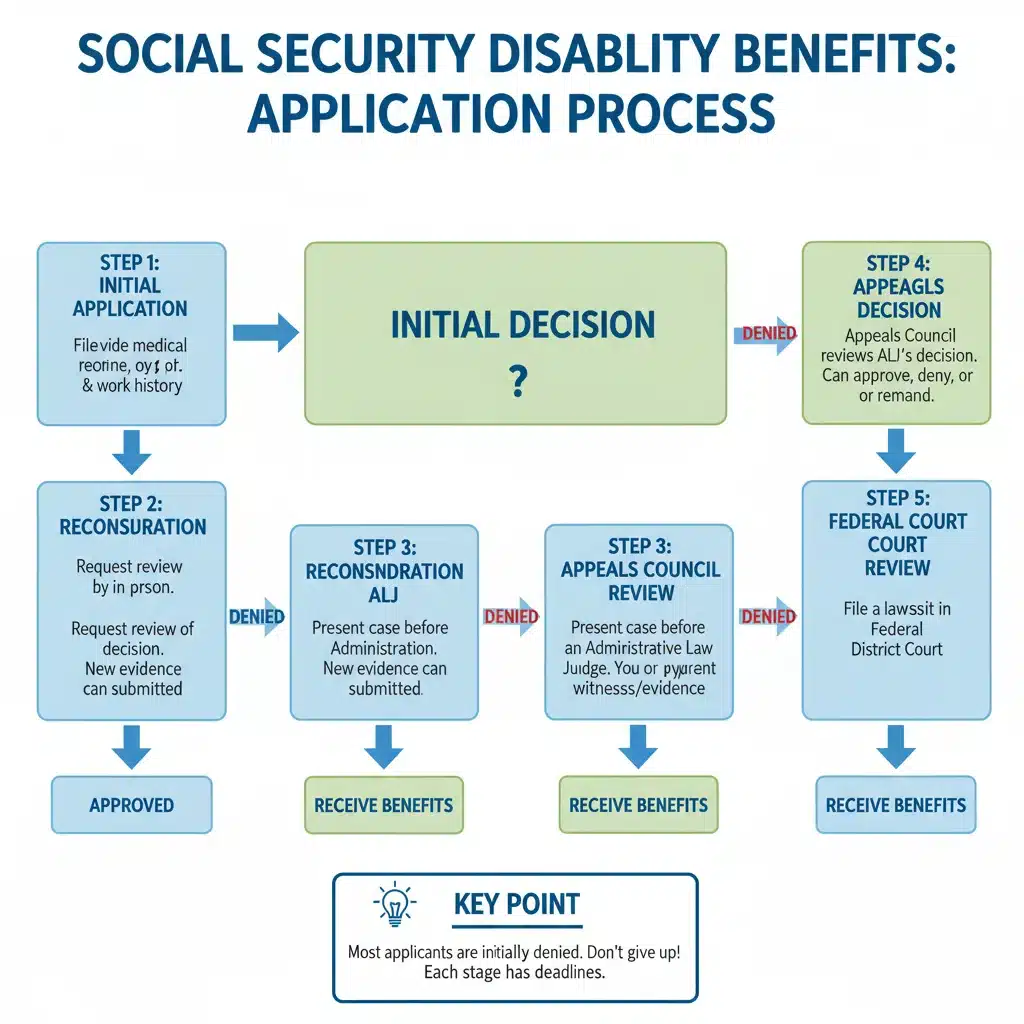
Stage 1: Initial Application
The first step is to complete the application for disability benefits. You can do this online, over the phone, or in person at a local Social Security office. For Disability Benefits 2026, the SSA will likely continue to emphasize online applications, potentially with enhanced user interfaces or guided assistance tools.
- Online Application: This is often the quickest and most convenient method. Ensure you have all necessary information before you start.
- Phone Application: You can call the SSA’s toll-free number to apply or schedule an appointment.
- In-Person Application: Visit your local Social Security office. It’s often best to call ahead and schedule an appointment.
Regardless of the method, you will need to provide extensive information, including:
- Personal information (name, date of birth, Social Security number).
- Medical history (names and addresses of doctors, hospitals, clinics, dates of treatment, medical records).
- Medications you are taking.
- Work history (employer names, dates of employment, job duties, earnings).
- Education and training.
- Information about your daily activities and how your condition affects them.
For Disability Benefits 2026, it’s possible that the SSA might introduce further streamlining of forms or requests for specific digital medical records, so staying updated on their website is crucial.
Stage 2: Disability Determination Services (DDS) Review
Once your application is submitted, it goes to a state agency called Disability Determination Services (DDS). DDS works for the SSA and is responsible for making the initial medical determination of disability. This is where your medical evidence becomes paramount.
DDS will:
- Obtain your medical records from the doctors, hospitals, and clinics you listed.
- May send you for a consultative examination (CE) with an independent doctor if there isn’t enough medical evidence to make a decision.
- Evaluate your medical condition against the SSA’s Blue Book (Listing of Impairments) and vocational factors.
The time it takes for DDS to make a decision can vary significantly, often ranging from three to six months or even longer. For Disability Benefits 2026, while the SSA continually strives to reduce processing times, the volume of applications and the thoroughness required for each claim mean that delays can still occur.
Stage 3: Reconsideration (First Appeal)
A significant number of initial applications are denied. If your application for Disability Benefits 2026 is denied, you have the right to appeal. The first level of appeal is called Reconsideration.
During Reconsideration, your case is reviewed by a different examiner at DDS. You can submit new medical evidence at this stage. It’s often beneficial to use this opportunity to provide additional documentation that strengthens your claim.
Stage 4: Hearing by an Administrative Law Judge (ALJ)
If your application is denied again at Reconsideration, the next step is to request a hearing before an Administrative Law Judge (ALJ). This is often your best chance of approval. At an ALJ hearing, you and your representative (if you have one) can present your case, testify about your condition, and question vocational or medical experts who may be present.
ALJ hearings for Disability Benefits 2026 will continue to be a critical stage, and having legal representation at this point significantly increases your chances of success. The judge will consider all evidence, including your testimony, medical records, and any new evidence presented.
Crucial Tips for a Successful Disability Benefits Application in 2026
Preparing a strong application for Disability Benefits 2026 requires more than just filling out forms. Here are essential tips to enhance your chances of approval:
- Seek Timely Medical Treatment: The SSA relies heavily on objective medical evidence. Consistently seeing a doctor, following prescribed treatments, and attending specialist appointments are critical. Gaps in treatment can be detrimental to your claim. Ensure all your medical records are up-to-date and thoroughly document your condition, symptoms, limitations, and prognosis.
- Provide Comprehensive and Consistent Medical Evidence: This is the backbone of your application. Ensure your doctors clearly document your diagnosis, treatment plan, response to treatment, and most importantly, your functional limitations. How does your condition prevent you from performing work-related activities (e.g., standing, sitting, lifting, concentrating)?
- Be Detailed and Honest on Your Application: Provide as much detail as possible about your medical conditions, symptoms, and how they impact your daily life and ability to work. Don’t exaggerate, but don’t downplay your struggles either. Inconsistencies can raise red flags.
- Maintain Communication with the SSA: Respond promptly to all requests for information from the SSA or DDS. Missing deadlines can lead to denial. Keep copies of everything you submit.
- Keep a Detailed Journal: Document your daily symptoms, limitations, side effects of medication, and how your condition affects your ability to perform routine tasks. This can be invaluable evidence, especially if you reach an ALJ hearing.
- Understand the SSA’s Definition of Disability: Remember, it’s not enough to have a severe medical condition; it must prevent you from engaging in substantial gainful activity for at least 12 months. Frame your application and evidence around this definition.
- Consider Professional Representation: While not mandatory, hiring an experienced disability attorney or advocate significantly increases your chances of approval, especially at the reconsideration and ALJ hearing levels. They understand the SSA’s rules, can gather and present evidence effectively, and represent your interests. They typically work on a contingency basis, meaning they only get paid if you win your case.
- Prepare for Consultative Examinations (CEs): If the SSA schedules you for a CE, treat it seriously. Be honest and thorough in describing your symptoms and limitations to the examining doctor. This is an opportunity to provide current medical information to the SSA.
- Be Patient: The disability application process can be lengthy. It’s not uncommon for it to take over a year, especially if appeals are necessary. Don’t get discouraged by initial denials.
Anticipated Changes and Considerations for 2026
While specific legislative changes are difficult to predict, several areas might see increased focus or minor adjustments for Disability Benefits 2026:
- Technological Advancements: The SSA has been investing in technology to streamline processes. Expect further enhancements in online application portals, digital submission of medical records, and potentially AI-assisted review processes for initial screening. This could mean faster processing for some, but also requires applicants to be comfortable with digital submissions.
- Focus on Telehealth: The expanded use of telehealth services, particularly post-pandemic, may lead to updated guidelines on how telehealth consultations and records are weighed as medical evidence. For Disability Benefits 2026, ensure your telehealth visits are as detailed and thorough as in-person ones.
- Mental Health Emphasis: There is a growing recognition of the impact of mental health conditions on an individual’s ability to work. While already a significant factor, expect continued emphasis on robust documentation for mental health claims, including regular therapy, psychiatric evaluations, and medication adherence.
- Vocational Experts’ Role: The role of vocational experts at ALJ hearings might be further refined. Understanding how your residual functional capacity (RFC) interacts with your past work and potential other jobs in the national economy will remain a critical aspect of the determination.
- Program Integrity Efforts: The SSA continuously works to ensure program integrity. This may involve enhanced review processes or data matching to identify fraud or ensure accurate payments. Honest and well-supported applications are key.
Common Pitfalls to Avoid When Applying for Disability Benefits in 2026
Understanding what not to do can be just as important as knowing what you should do. Here are common mistakes that can derail your application for Disability Benefits 2026:
- Incomplete Applications: Submitting an application with missing information or sections left blank is a major red flag and can lead to immediate delays or denials. Double-check everything before submission.
- Lack of Consistent Medical Treatment: If your medical records show long gaps between doctor visits or a failure to follow prescribed treatment, the SSA may question the severity or persistence of your condition.
- Insufficient Medical Evidence: Relying solely on your own testimony without objective medical evidence (e.g., diagnostic test results, doctor’s notes detailing limitations) is a common mistake. The SSA needs concrete proof from medical professionals.
- Failure to Appeal Denials: Many eligible individuals give up after the first denial. The appeals process is there for a reason, and many cases are approved at later stages, particularly at the ALJ hearing.
- Working Above Substantial Gainful Activity (SGA) Levels: If you are working and earning above the SGA limit (which typically adjusts annually, and will be updated for 2026), you will generally not be considered disabled by the SSA’s definition, regardless of your medical condition.
- Poor Communication with Medical Providers: Ensure your doctors understand that the purpose of your visits is not just treatment, but also documentation for your disability claim. Discuss your functional limitations openly with them.
- Not Informing the SSA of New Information: If your medical condition changes, you start new treatment, or your contact information updates, inform the SSA immediately.
- Failing to Prepare for Consultative Exams: Treat CEs seriously. Be prepared to clearly articulate your symptoms and limitations to the examining doctor. This is often the only time the SSA directly observes you.
The Role of Medical Evidence in 2026 Disability Claims
Medical evidence is the bedrock of any successful Social Security Disability claim. For Disability Benefits 2026, this will remain the most critical component. The SSA uses your medical records to answer several key questions:
- Do you have a medically determinable impairment? This requires objective medical evidence, not just your subjective complaints.
- Is your impairment severe? Does it significantly limit your ability to perform basic work activities?
- Does your impairment meet or medically equal an SSA Listing? The ‘Blue Book’ contains a list of impairments that are considered severe enough to prevent an individual from engaging in SGA. Meeting a listing can lead to a quick approval.
- Can you perform your past relevant work? If not, can you perform any other work that exists in significant numbers in the national economy? This is where your Residual Functional Capacity (RFC) assessment is crucial.
To ensure your medical evidence is as strong as possible, focus on:
- Diagnostic Test Results: X-rays, MRIs, CT scans, blood tests, nerve conduction studies, psychological evaluations, and other objective tests provide concrete proof of your condition.
- Physician’s Notes and Reports: These should detail your symptoms, the progression of your disease, treatment plans, response to treatment, and explicitly state your functional limitations (e.g., how long you can stand, sit, lift, concentrate, interact with others).
- Specialist Opinions: If you have a complex condition, reports from specialists (e.g., neurologists, cardiologists, psychiatrists, orthopedists) are highly valued.
- Medication Lists and Side Effects: Document all medications you take and any debilitating side effects.
- Therapy Notes: For mental health conditions, notes from therapists or counselors are essential.
It’s beneficial to ask your treating physician to complete an RFC form specifically designed for the SSA, detailing your limitations. A doctor’s opinion that is well-supported by objective medical evidence and consistent with the overall record holds significant weight.
Conclusion: Preparing for Disability Benefits in 2026
The journey to securing Social Security Disability Benefits can be challenging, but with proper preparation and understanding, it is achievable. As we look towards Disability Benefits 2026, the emphasis remains on thorough documentation, consistent medical treatment, and diligent adherence to the SSA’s application and appeal procedures.
While specific legislative overhauls are unlikely in the immediate future, subtle shifts in policy, administrative processes, and the SSA’s interpretation of evidence can impact outcomes. Staying informed through the official Social Security Administration website, consulting with experienced disability attorneys or advocates, and meticulously gathering your medical evidence are your best strategies for navigating the system successfully.
Remember, an initial denial is not the end of the road. Many successful claims for Disability Benefits 2026 will likely go through the appeals process. By understanding the requirements, avoiding common pitfalls, and building a compelling case supported by robust medical evidence, you can significantly improve your chances of receiving the disability benefits you deserve. Don’t hesitate to seek professional guidance; it can make a substantial difference in the ultimate outcome of your claim.