Navigating Federal Student Loan Repayment 2026: Your Essential Guide

For millions of Americans, student loans represent a significant financial commitment. The landscape of federal student loan repayment has been in a state of flux, with various initiatives and policy changes aiming to provide relief and more manageable payment options. As we approach 2026, it’s crucial for borrowers to understand the evolving framework, particularly the new and refined repayment plans that will soon be fully implemented. This comprehensive guide aims to demystify the upcoming changes, with a special focus on the SAVE Plan (Saving on a Valuable Education), and equip you with the knowledge to make informed decisions about your financial future concerning your Student Loan Repayment 2026.
The Evolving Landscape of Federal Student Loan Repayment
The federal student loan system is designed to help students finance their education, but the repayment process can often feel overwhelming. Over the past few years, the U.S. Department of Education has introduced significant reforms to make repayment more affordable and accessible. These changes are part of a broader effort to address the national student debt crisis, which affects millions of borrowers and has implications for the wider economy. Understanding these changes is not just about compliance; it’s about optimizing your financial health and reducing the burden of student debt.
Historically, borrowers have had several repayment options, including standard, graduated, extended, and various income-driven repayment (IDR) plans. While these options offered some flexibility, many borrowers still struggled with high monthly payments relative to their income. The goal of the recent reforms, culminating in the changes we’ll see fully in 2026, is to create a more equitable and sustainable system. These reforms aim to prevent loan defaults, reduce the accumulation of interest, and provide a clearer path to loan forgiveness for eligible borrowers.
The primary driver behind many of these changes is the recognition that a one-size-fits-all approach to student loan repayment simply doesn’t work. Borrowers come from diverse financial backgrounds, pursue different career paths, and experience varying levels of income throughout their lives. A flexible system that adapts to these individual circumstances is essential for promoting both individual financial well-being and broader economic stability. Therefore, preparing for Student Loan Repayment 2026 means understanding these foundational shifts.
Why 2026 is a Pivotal Year for Student Loan Borrowers
While some aspects of new repayment plans, like the SAVE Plan, have already begun to roll out, 2026 marks a significant milestone for the full implementation of key provisions. This includes critical adjustments to how monthly payments are calculated, the expansion of interest subsidies, and changes to the loan forgiveness timelines. These changes are not minor tweaks; they represent a fundamental restructuring of how federal student loans will be repaid, offering potentially substantial benefits to many borrowers. For anyone with federal student loans, proactive engagement with these changes is paramount.
The transition period can be confusing, with different rules applying at different times. However, by 2026, the new framework is expected to be fully operational, providing a more stable and predictable environment for borrowers. This stability will allow for better long-term financial planning and a clearer understanding of future obligations. Therefore, learning about Student Loan Repayment 2026 now will give you a significant advantage in managing your debt effectively.
Deep Dive into the SAVE Plan: The Cornerstone of New Repayment Options
The Saving on a Valuable Education (SAVE) Plan is the most significant new income-driven repayment (IDR) plan, designed to replace the Revised Pay As You Earn (REPAYE) Plan. It offers the most generous terms ever available to federal student loan borrowers, aiming to significantly reduce monthly payments and prevent interest capitalization. Understanding the nuances of the SAVE Plan is critical for any borrower looking to optimize their Student Loan Repayment 2026 strategy.
Key Features and Benefits of the SAVE Plan
The SAVE Plan introduces several borrower-friendly provisions:
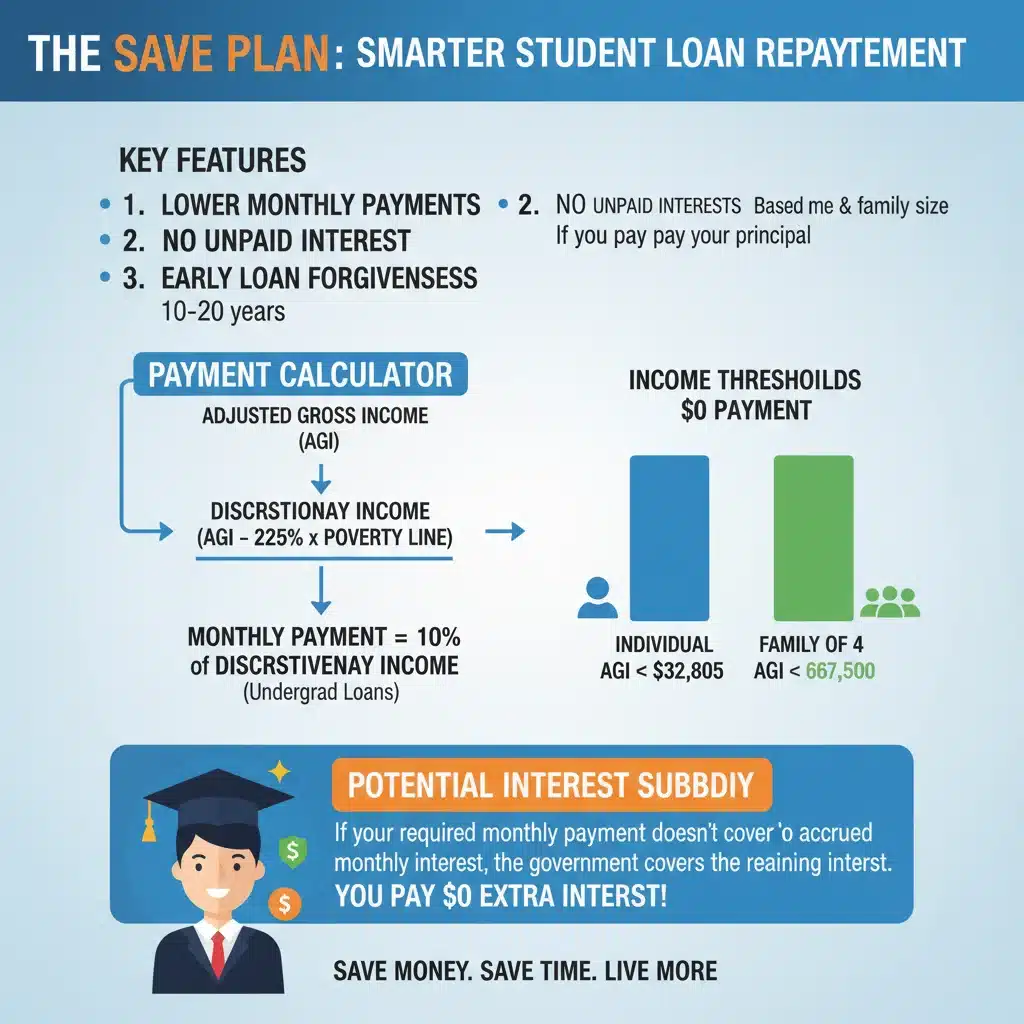
- Lower Monthly Payments: For undergraduate loans, monthly payments are reduced from 10% to 5% of a borrower’s discretionary income. Borrowers with both undergraduate and graduate loans will pay a weighted average between 5% and 10%.
- Increased Discretionary Income Threshold: The amount of income protected from repayment calculations has increased from 150% to 225% of the federal poverty line. This means more of your income is considered non-discretionary, leading to lower or even $0 monthly payments for many low-income borrowers.
- Interest Subsidy: This is a game-changer. If your calculated monthly payment doesn’t cover the monthly interest, the government covers the remaining interest. This means your loan balance will not grow due to unpaid interest, even if your payments are $0. This prevents the common problem of loan balances ballooning under other IDR plans.
- Shorter Path to Forgiveness for Smaller Balances: Borrowers with original principal balances of $12,000 or less can receive forgiveness after just 10 years of payments. For every additional $1,000 borrowed above $12,000, one additional year of payments is added, up to a maximum of 20 or 25 years.
- Automatic Enrollment for Delinquent Borrowers: In some cases, borrowers who are significantly delinquent on their loans may be automatically enrolled in the SAVE Plan to prevent default.
- Spousal Income Exclusion: For married borrowers who file separately, spousal income is excluded from the payment calculation for the SAVE Plan, offering significant relief compared to previous IDR plans.
These features collectively make the SAVE Plan a powerful tool for managing federal student debt, especially for those with lower incomes or significant loan balances. It represents a fundamental shift towards a more supportive repayment environment.
Who Benefits Most from the SAVE Plan?
While many borrowers will find the SAVE Plan advantageous, it particularly benefits:
- Low-income borrowers: With the increased discretionary income threshold and the 5% payment rate, many will qualify for $0 monthly payments.
- Borrowers with high loan balances relative to their income: The interest subsidy ensures that their balance won’t grow, even if their payments are minimal.
- Single parents or those with large families: The higher poverty line exclusion (which increases with family size) means more protected income.
- Borrowers pursuing public service careers: Those working towards Public Service Loan Forgiveness (PSLF) will find the SAVE Plan’s low payments and interest subsidy highly beneficial, as their remaining balance is forgiven tax-free after 10 years of qualifying payments.
Understanding if you fall into one of these categories is crucial for determining if the SAVE Plan is your best option for Student Loan Repayment 2026.
How to Enroll in or Switch to the SAVE Plan
If you are currently enrolled in REPAYE, you will be automatically transitioned to the SAVE Plan. For borrowers on other IDR plans (PAYE, IBR, ICR) or standard repayment plans, you will need to apply to switch. The application process is typically done through StudentAid.gov. You’ll need to provide information about your income and family size. It’s recommended to update this information annually, or whenever your financial situation changes significantly, to ensure your payments are accurately calculated. Don’t delay in exploring this option as part of your Student Loan Repayment 2026 planning.
Other Income-Driven Repayment (IDR) Plans for 2026
While the SAVE Plan is taking center stage, other IDR plans will still be available for borrowers who may find them more suitable or who are not eligible for SAVE. It’s essential to compare all available options to determine the best fit for your individual circumstances as you navigate Student Loan Repayment 2026.
Pay As You Earn (PAYE)
The PAYE Plan calculates your monthly payment at 10% of your discretionary income, capped at the amount you would pay under the Standard Repayment Plan. Loan forgiveness is available after 20 years of payments. PAYE might be beneficial for borrowers who have a relatively high income but want the protection of a payment cap, which the SAVE Plan does not have. However, PAYE does not offer the same interest subsidy as SAVE, meaning your balance could still grow if your payments don’t cover the interest.
Income-Based Repayment (IBR)
The IBR Plan calculates payments at either 10% or 15% of your discretionary income, depending on when you took out your loans, and also caps payments at the Standard Repayment Plan amount. Loan forgiveness is available after 20 or 25 years. IBR is generally less generous than SAVE or PAYE for most borrowers due to the higher payment percentage for some and the lack of an interest subsidy. However, some older loans may only be eligible for IBR. For Student Loan Repayment 2026, it’s worth reviewing if any of your older loans might fall into this category.
Income-Contingent Repayment (ICR)
The ICR Plan is the oldest IDR plan and calculates payments based on 20% of your discretionary income or what you’d pay on a fixed 12-year repayment plan, whichever is less. Forgiveness is available after 25 years. ICR is generally the least generous IDR plan and is often used by borrowers with Parent PLUS loans (which can become eligible for IDR via consolidation) or those who don’t qualify for other IDR plans. It’s unlikely to be the most advantageous option for most borrowers in Student Loan Repayment 2026.
Choosing the Right IDR Plan
The decision of which IDR plan to choose depends on several factors, including:
- Your income and family size: These directly impact your discretionary income calculation.
- Your total loan balance and interest rates: Higher balances may benefit more from interest subsidies.
- Your current and projected career path: Especially if you’re pursuing PSLF.
- Whether you have graduate or undergraduate loans: This affects the payment percentage under SAVE.
- Your marital status and tax filing strategy: This can significantly impact your payment calculation, especially with the SAVE Plan’s spousal income exclusion.
It’s highly recommended to use the Loan Simulator tool on StudentAid.gov to compare different repayment plans and see how they would affect your monthly payments and total repayment costs. This tool is invaluable for planning your Student Loan Repayment 2026 strategy.
Strategies for Managing Your Student Loans in 2026 and Beyond
Beyond choosing the right repayment plan, several other strategies can help you effectively manage your federal student loans in 2026 and beyond. A proactive approach to debt management can save you money, reduce stress, and help you achieve financial freedom sooner.
1. Stay Informed and Update Your Information Annually
The federal student loan landscape can change. Make it a habit to regularly check StudentAid.gov for updates and news. More importantly, if you are on an IDR plan, you must recertify your income and family size annually. Failing to do so can result in your payments reverting to the standard amount, and any unpaid interest may capitalize (be added to your principal balance). This annual recertification is a crucial step for maintaining affordable payments under any IDR plan, including the SAVE Plan, for your Student Loan Repayment 2026.
2. Consider Public Service Loan Forgiveness (PSLF)
If you work for a qualifying government or non-profit organization, you might be eligible for Public Service Loan Forgiveness (PSLF). Under PSLF, your remaining loan balance is forgiven tax-free after 120 qualifying monthly payments (10 years) made while working full-time for an eligible employer. The SAVE Plan is particularly beneficial for PSLF-eligible borrowers because it offers the lowest possible payments, and the interest subsidy ensures your balance doesn’t grow while you’re working towards forgiveness. Make sure to certify your employment annually to track your progress towards PSLF.
3. Explore Loan Consolidation
Federal Direct Loan Consolidation allows you to combine multiple federal student loans into a single new Direct Consolidation Loan. This can simplify your repayment by giving you one monthly payment and potentially offering access to additional repayment plans (like certain IDR plans for Parent PLUS loans, which become eligible only after consolidation). Consolidation also allows you to lock in a fixed interest rate, which is the weighted average of your original loans’ interest rates. While it doesn’t always lower your interest rate, it can be a valuable tool for streamlining your Student Loan Repayment 2026 strategy.
4. Understand Forbearance and Deferment Options
If you encounter temporary financial hardship, federal student loans offer options like forbearance and deferment. These allow you to temporarily pause or reduce your payments. However, interest typically accrues during forbearance (unless it’s a specific type of deferment or a subsidized loan in deferment), potentially increasing your total loan cost. Always understand the implications before using these options and consider them a last resort after exploring IDR plans, especially the SAVE Plan, which is designed to make payments affordable even during low-income periods. For the optimal Student Loan Repayment 2026, these should be temporary solutions.

5. Make Extra Payments When Possible
If your financial situation improves and you’re on a repayment plan that allows it (most do), making extra payments can significantly reduce the total interest paid and shorten your repayment period. Even small extra payments can make a big difference over time. Ensure that any extra payments are applied directly to the principal balance of your highest-interest loan first, if you have multiple loans. This is a powerful strategy for accelerating your Student Loan Repayment 2026 progress.
6. Build an Emergency Fund
Having an emergency fund is crucial for financial stability, especially when managing long-term debt like student loans. An emergency fund can help you cover unexpected expenses without derailing your loan payments or forcing you into forbearance. Aim for at least 3-6 months’ worth of essential living expenses. This financial cushion provides peace of mind and resilience against unforeseen challenges, making your Student Loan Repayment 2026 journey smoother.
7. Seek Professional Financial Advice
Navigating federal student loan repayment can be complex, and every borrower’s situation is unique. If you’re feeling overwhelmed or unsure about the best path forward, consider consulting a reputable financial advisor specializing in student loan debt. They can provide personalized advice, help you compare options, and develop a tailored strategy for your Student Loan Repayment 2026 goals.
Common Misconceptions About Student Loan Repayment
Despite efforts to clarify the rules, several misconceptions persist that can hinder borrowers from making the best decisions for their Student Loan Repayment 2026.
Misconception 1: My payments will always be high.
Reality: This is one of the most dangerous myths. Income-driven repayment plans, especially the SAVE Plan, are specifically designed to make payments affordable based on your income and family size. Many borrowers, particularly those with lower incomes, can qualify for $0 monthly payments. It’s crucial to explore these options before assuming your payments are unmanageable.
Misconception 2: If I’m struggling, my only option is to default.
Reality: Defaulting on student loans has severe consequences, including damaged credit, wage garnishment, and loss of eligibility for future federal aid. There are numerous alternatives, such as IDR plans, deferment, and forbearance, designed to help you avoid default. Always communicate with your loan servicer if you’re struggling to make payments.
Misconception 3: Loan forgiveness is impossible to achieve.
Reality: While it requires consistent effort and meeting specific criteria, loan forgiveness through programs like PSLF or IDR plans is a real possibility for many borrowers. The SAVE Plan, with its shorter forgiveness timelines for smaller balances and continuous interest subsidy, makes forgiveness more attainable than ever for a significant portion of borrowers. Don’t dismiss it as an option for your Student Loan Repayment 2026.
Misconception 4: Consolidating my loans will lower my interest rate.
Reality: Federal Direct Loan Consolidation calculates a new interest rate as the weighted average of your existing loans’ rates, rounded up to the nearest one-eighth of a percentage point. It does not automatically lower your interest rate. Its main benefits are simplifying payments and potentially gaining access to new repayment plans or PSLF eligibility for certain loans.
Misconception 5: All student loans are the same.
Reality: There’s a significant difference between federal and private student loans. Federal loans come with a wide array of borrower protections, including IDR plans, deferment, forbearance, and forgiveness programs. Private loans generally do not offer these protections and typically have fewer flexible repayment options. This guide focuses exclusively on federal student loans and the opportunities for Student Loan Repayment 2026.
The Importance of Proactive Planning for 2026
As 2026 approaches, the message for federal student loan borrowers is clear: proactive planning is essential. The new repayment options, particularly the SAVE Plan, offer unprecedented opportunities to manage your debt more effectively, reduce monthly burdens, and potentially achieve forgiveness sooner. However, these benefits are not automatic for everyone; they require understanding, engagement, and often, action on your part.
Take the time now to:
- Review your current loan portfolio: Understand the types of loans you have (subsidized, unsubsidized, Direct, FFEL, PLUS) and their current interest rates.
- Assess your financial situation: Calculate your current income, family size, and monthly expenses.
- Use the StudentAid.gov Loan Simulator: This tool is your best friend for comparing different repayment plans and projecting your future payments and forgiveness eligibility.
- Contact your loan servicer: If you have questions or need clarification, your loan servicer is a primary resource.
- Consider your long-term goals: Are you aiming for PSLF? Do you want to pay off your loans as quickly as possible? Your goals will influence your optimal repayment strategy.
The changes coming in Student Loan Repayment 2026 are designed to offer relief and a clearer path forward for millions. By arming yourself with knowledge and taking deliberate steps, you can harness these new opportunities to take control of your student loan debt and build a stronger financial future.
Conclusion: Empowering Your Student Loan Journey in 2026
The federal student loan repayment landscape is undergoing a transformative shift, with 2026 marking a critical juncture for borrowers. The introduction and full implementation of the SAVE Plan, alongside other established income-driven repayment options, provide a robust framework designed to make student loan debt more manageable and lead to more accessible forgiveness pathways. This guide has aimed to illuminate the complexities of these changes, emphasizing the unparalleled benefits of the SAVE Plan, particularly its lower payment calculations and groundbreaking interest subsidy.
Navigating Student Loan Repayment 2026 requires more than just awareness; it demands active participation. Borrowers must commit to understanding their options, utilizing available resources like the Loan Simulator, and proactively engaging with their loan servicers. Whether you are a recent graduate, a seasoned professional, or someone facing financial hardship, there is likely a federal repayment option that can significantly alleviate your burden.
Remember that knowledge is your most powerful tool. By staying informed, regularly updating your financial information, and strategically choosing the repayment plan that aligns with your income and career goals, you can transform your student loan journey from a source of stress into a manageable part of your broader financial plan. The federal government has provided the tools; it is now up to you to leverage them effectively. Embrace the opportunities presented by the new era of Student Loan Repayment 2026 and take confident steps toward financial freedom.