US Social Security Reforms 2026: What Retirees Need to Know

The landscape of retirement planning in the United States is perpetually shifting, and few topics stir as much debate and concern as the future of Social Security. As we approach 2026, the discussion around potential Social Security reforms is intensifying, with implications that could profoundly affect millions of current and future retirees. Understanding these proposed changes is not merely an academic exercise; it’s a crucial step in safeguarding your financial well-being during your golden years. This comprehensive guide will delve into the intricacies of the looming reforms, explore their potential impact, and equip you with the knowledge to navigate this evolving environment.
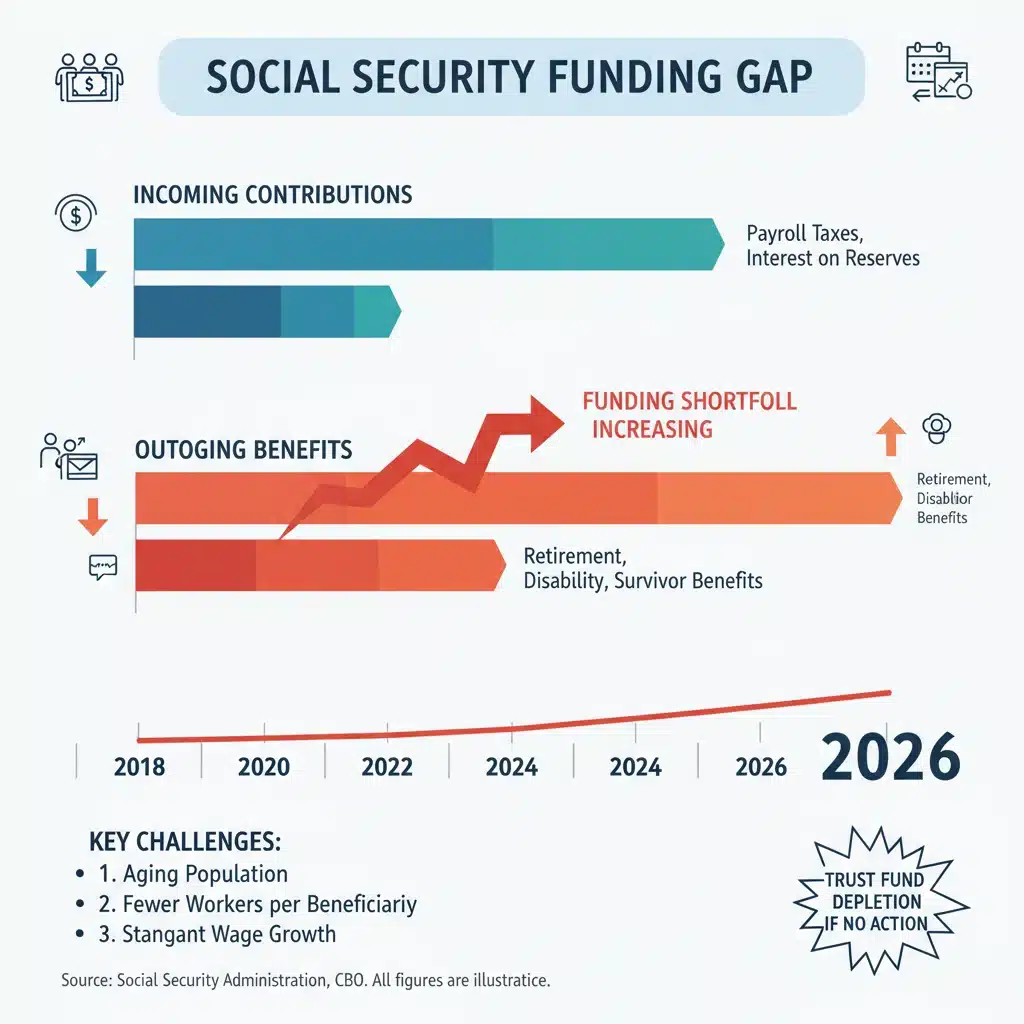
Social Security, established in 1935, has been a cornerstone of American retirement security for generations. It provides a vital safety net, offering income to retirees, the disabled, and survivors of deceased workers. However, demographic shifts, including increased life expectancy and lower birth rates, coupled with economic fluctuations, have placed significant strain on the system’s long-term solvency. Projections indicate that without intervention, the Social Security trust funds may be unable to meet their obligations in full in the coming decades, making Social Security reforms an urgent necessity.
The Urgency for Social Security Reforms: Why 2026 Matters
The year 2026 is often cited in discussions about Social Security because it represents a critical juncture in the system’s financial projections. While the exact dates can vary slightly based on different actuarial reports, the general consensus is that the Old-Age and Survivors Insurance (OASI) Trust Fund, which pays retirement and survivor benefits, will face significant challenges around this period. The Hospital Insurance (HI) Trust Fund, which pays for Medicare Part A, also faces similar pressures. The combined trust funds are projected to be able to pay 100 percent of scheduled benefits until the mid-2030s, but after that, they will only be able to pay a reduced percentage if no legislative action is taken. This looming shortfall is the primary driver behind the push for significant Social Security reforms.
The problem is fundamentally one of demographics. When Social Security was created, there were many more workers contributing for each retiree receiving benefits. Today, that ratio has shrunk considerably. Longer lifespans mean retirees are collecting benefits for more years, and lower birth rates mean fewer new workers are entering the workforce to replenish the system. This imbalance creates a fiscal gap that requires thoughtful and strategic solutions. Ignoring these challenges would mean an automatic reduction in benefits for all recipients, a scenario policymakers are keen to avoid through proactive Social Security reforms.
Understanding the Current State of Social Security
Before diving into potential reforms, it’s essential to grasp the current structure and how it’s funded. Social Security is primarily a pay-as-you-go system, meaning current workers’ contributions largely fund the benefits of current retirees. The system is financed through dedicated payroll taxes, specifically the Federal Insurance Contributions Act (FICA) tax. Employees and employers each pay 6.2% on earnings up to an annual limit ($168,600 in 2024), while self-employed individuals pay the full 12.4%. A portion of these taxes goes to the OASI Trust Fund, and another portion goes to the Disability Insurance (DI) Trust Fund. Medicare taxes are separate.
The trust funds hold reserves that have been built up over time, primarily from periods when income exceeded outgo. These reserves are invested in special interest-bearing U.S. Treasury securities. However, for several years now, Social Security’s outgo has exceeded its non-interest income, requiring the system to draw down on these reserves. This drawdown is projected to accelerate, eventually depleting the reserves unless changes are made. This looming depletion is what makes discussions about Social Security reforms so critical and time-sensitive.
The benefits received by retirees are based on a progressive formula that takes into account an individual’s highest 35 years of earnings. This formula is designed to replace a higher percentage of pre-retirement earnings for lower-income workers, ensuring a basic level of income security for all. The full retirement age (FRA) has been gradually increasing and is now 67 for those born in 1960 or later. Claiming benefits before your FRA results in a permanent reduction, while delaying benefits past your FRA (up to age 70) results in a permanent increase. These parameters are all potential targets for future Social Security reforms.
Key Proposed Social Security Reforms for 2026 and Beyond
Numerous proposals for Social Security reforms have been put forward by politicians, economists, and advocacy groups. These proposals generally fall into a few broad categories: increasing revenue, decreasing benefits, or a combination of both. Here’s a look at some of the most frequently discussed ideas:
1. Increasing the Full Retirement Age (FRA)
One of the most common proposals is to gradually raise the FRA beyond 67. Proponents argue that as people live longer and remain healthier into older age, it makes sense to adjust the age at which full benefits are received. This would reduce the total amount paid out over a retiree’s lifetime. Critics contend that this disproportionately affects individuals in physically demanding jobs and those with lower life expectancies.
2. Adjusting the Cost-of-Living Adjustment (COLA) Formula
Social Security benefits are adjusted annually based on the Cost-of-Living Adjustment (COLA) to help beneficiaries maintain their purchasing power. Some proposals suggest modifying the COLA calculation, perhaps by using a different inflation index (e.g., the Chained CPI, which typically grows slower than the current CPI-W). This would result in slightly smaller annual increases, saving the system money over time. However, this could erode the buying power of retirees, especially those on fixed incomes.
3. Raising the Payroll Tax Cap
Currently, earnings above a certain threshold (e.g., $168,600 in 2024) are not subject to Social Security payroll taxes. One popular reform idea is to raise or eliminate this cap, meaning higher earners would contribute more to the system. This measure is often favored by those who believe in progressive taxation, as it would primarily affect wealthier individuals. Opponents argue it could disincentivize work and investment.
4. Increasing the Payroll Tax Rate
A more direct approach to increasing revenue is to raise the Social Security payroll tax rate (currently 6.2% for employees and employers each). Even a small increase, such as 1% for both employees and employers, could significantly improve the system’s solvency. However, this is often politically unpopular as it represents a direct tax increase on all working Americans.
5. Modifying the Benefit Formula
Some proposals suggest altering the progressive benefit formula, perhaps by reducing the benefit factor for higher earners or adjusting the bend points in the formula. This would mean that while all retirees would still receive benefits, higher earners might see a smaller percentage of their pre-retirement income replaced. This is another form of means-testing, designed to direct more resources to those who need them most.
6. Means-Testing Social Security Benefits
Means-testing would involve reducing or eliminating Social Security benefits for high-income retirees, based on their total income or wealth. The argument is that those who are financially secure may not need the full benefit. Critics argue this goes against the universal insurance principle of Social Security and could discourage saving for retirement.
7. Investing a Portion of Trust Funds in Equities
A more radical proposal involves allowing a portion of the Social Security trust funds to be invested in private securities, such as stocks, which historically offer higher returns than government bonds. While this could potentially boost the trust funds’ growth, it also introduces greater risk and volatility, a concern for a system designed for stability.
Potential Impacts on Current and Future Retirees
The specific impact of any Social Security reforms will depend entirely on which proposals are enacted and how they are structured. However, we can anticipate general effects based on the types of changes:
For Current Retirees (Already Receiving Benefits)
- Benefit Reductions: If reforms involve across-the-board benefit cuts or significant COLA adjustments, current retirees could see their monthly payments decrease in real terms.
- No Change: Many proposals aim to protect current retirees from benefit cuts, focusing instead on future beneficiaries. However, this is not guaranteed.
- Increased Stability: Successful reforms would ensure the long-term solvency of the system, providing greater peace of mind that benefits will continue without interruption, even if at a slightly adjusted rate.
For Near-Term Retirees (5-10 Years from Retirement)
- Higher Full Retirement Age: If the FRA is raised, those nearing retirement might find themselves working longer than anticipated to receive their full benefits.
- Adjusted Benefit Formula: Changes to the benefit calculation could slightly alter their expected monthly payments.
- COLA Modifications: Any changes to the COLA formula would affect the purchasing power of their benefits throughout retirement.
For Future Generations (Younger Workers)
- Higher Taxes: If payroll taxes are increased or the cap is lifted, younger workers will contribute more during their working lives.
- Later Retirement: A higher FRA would mean a later start to collecting full benefits, potentially shifting retirement ages.
- Potentially Lower Benefits: Depending on the severity of benefit formula adjustments or means-testing, future generations might receive a smaller proportion of their pre-retirement income from Social Security.
- More Secure System: On the positive side, successful Social Security reforms would mean that the system remains solvent and capable of paying benefits for their entire retirement, avoiding a much larger crisis later.
Navigating the Changes: Strategies for Retirement Planning
Given the uncertainty surrounding future Social Security reforms, it’s more important than ever for individuals to take a proactive approach to retirement planning. Relying solely on Social Security for your retirement income is a risky strategy, and diversification is key. Here are some strategies to consider:
1. Maximize Your Savings
Increase contributions to tax-advantaged retirement accounts such as 401(k)s, 403(b)s, IRAs (Traditional or Roth), and HSAs (Health Savings Accounts if eligible). The more you save independently, the less reliant you’ll be on Social Security, regardless of any future reforms. Consider automating your savings to ensure consistency.
2. Diversify Your Retirement Income Streams
Don’t put all your eggs in one basket. In addition to Social Security and traditional retirement accounts, explore other income sources. This could include:
- Personal Investments: Stocks, bonds, mutual funds, ETFs.
- Real Estate: Rental properties or leveraging your home equity.
- Part-time Work in Retirement: Many retirees choose to work part-time, not just for income but also for social engagement and purpose.
- Annuities: Consider purchasing an annuity to guarantee a stream of income in retirement.
3. Understand Your Social Security Statement
Regularly review your annual Social Security statement, which you can access online through the Social Security Administration (SSA) website. This statement provides an estimate of your future benefits at different claiming ages, based on your earnings record. Understanding these estimates is crucial for your planning and for assessing the potential impact of any Social Security reforms.
4. Consider Working Longer
If the Full Retirement Age is increased, or if you simply want to boost your benefits, working an extra few years can have a significant positive impact. Delaying Social Security benefits past your FRA (up to age 70) earns you delayed retirement credits, permanently increasing your monthly payment. Additionally, more years of earnings can replace lower-earning years in your benefit calculation, potentially increasing your average indexed monthly earnings (AIME).
5. Explore Health Savings Accounts (HSAs)
HSAs offer a triple tax advantage: tax-deductible contributions, tax-free growth, and tax-free withdrawals for qualified medical expenses. They can be an excellent way to save for healthcare costs in retirement, which are often a significant and unpredictable expense. Having a robust healthcare savings plan can reduce the financial pressure if Social Security reforms affect your income.
6. Consult a Financial Advisor
A qualified financial advisor can help you assess your current financial situation, understand the potential implications of Social Security reforms, and develop a personalized retirement plan. They can help you model different scenarios and create strategies to mitigate risks and achieve your retirement goals.

The Political Landscape of Social Security Reforms
Any significant Social Security reforms face considerable political hurdles. The program is immensely popular, and changes that reduce benefits or increase taxes are often met with strong public opposition. Politicians are acutely aware of the potential backlash from voters, particularly seniors who represent a powerful voting bloc.
The challenge lies in finding a bipartisan consensus on a package of reforms that is both fiscally responsible and politically palatable. Democrats often favor solutions that involve increasing taxes on higher earners, such as raising or eliminating the payroll tax cap. Republicans, on the other hand, tend to lean towards benefit adjustments, such as raising the full retirement age or modifying the COLA, while generally opposing tax increases.
The closer we get to the projected insolvency dates, the more urgent the need for action becomes. However, the political will to make difficult decisions often only materializes when the crisis is imminent. This dynamic means that comprehensive Social Security reforms are likely to be a result of intense negotiation and compromise, potentially combining elements from various proposals.
What to Expect as 2026 Approaches
As 2026 draws nearer, expect to see increased media coverage and political rhetoric surrounding Social Security reforms. Advocacy groups for seniors, workers, and taxpayers will likely amplify their calls for specific solutions. It’s crucial for individuals to stay informed, differentiate between genuine proposals and political posturing, and understand how any potential changes could personally affect them.
While the exact timing and nature of reforms remain uncertain, the general direction is clear: the system needs adjustments to ensure its long-term viability. These adjustments will likely involve some combination of revenue increases and benefit modifications. The goal of policymakers will be to implement changes that are gradual, predictable, and fair, minimizing disruption to current and near-term retirees while securing the system for future generations.
Conclusion: Proactive Planning for a Secure Retirement
The discussion around Social Security reforms for 2026 and beyond is not just about numbers and policies; it’s about the financial security and peace of mind of millions of Americans. While the political process unfolds, the most empowering action you can take is to be proactive in your own retirement planning. Don’t assume Social Security will provide all the income you need, or that it will remain unchanged. Instead, view it as one pillar of a multi-faceted retirement strategy.
By maximizing your personal savings, diversifying your income streams, staying informed about potential policy changes, and seeking professional financial advice, you can build a resilient retirement plan that can withstand whatever Social Security reforms may bring. The future is uncertain, but your preparation doesn’t have to be. Start planning today to ensure your golden years are truly golden.