Supreme Court Environmental Rulings 2026: Future Impact Analysis
The landscape of environmental protection in the United States is perennially shaped by judicial decisions, with the Supreme Court sitting at its apex. As we move beyond 2026, a series of landmark Supreme Court environmental rulings have emerged, poised to redefine the trajectory of environmental regulations for the next half-decade and potentially far beyond. This insider analysis delves deep into these pivotal decisions, dissecting their immediate implications, forecasting their long-term effects, and providing strategic insights for industries, policymakers, and environmental advocates alike.
The year 2026 has proven to be a watershed moment for environmental law, marked by several cases that challenged long-standing interpretations of federal authority, state responsibilities, and corporate accountability in environmental matters. Understanding these rulings is not merely an academic exercise; it is crucial for navigating the evolving regulatory environment and anticipating future challenges and opportunities.
The Shifting Sands of Federal Environmental Authority
One of the most significant themes emerging from the 2026 term is the Supreme Court’s re-evaluation of federal agencies’ power to promulgate and enforce environmental regulations. Historically, agencies like the Environmental Protection Agency (EPA) have wielded considerable power under statutes such as the Clean Air Act and the Clean Water Act, often interpreting broad congressional mandates to address complex environmental challenges. However, recent Supreme Court environmental rulings have signaled a more constrained view of this authority.
Specifically, the Court’s application of the ‘major questions doctrine’ has been more pronounced. This doctrine, which posits that agencies must have clear congressional authorization for regulations that have vast economic or political significance, has been a potent tool for limiting agency reach. In 2026, this doctrine was applied in at least two key cases that directly impacted the EPA’s ability to regulate greenhouse gas emissions from certain industrial sectors and to define the scope of ‘waters of the United States’ (WOTUS) under the Clean Water Act.
The implications of this shift are profound. Industries that have long operated under the assumption of robust federal oversight may find themselves facing a more fragmented regulatory landscape, where state-level regulations gain prominence. For environmental groups, this necessitates a strategic pivot, focusing more on state legislative efforts and litigation, and perhaps advocating for clearer, more explicit congressional mandates for federal agencies.
The first major ruling, United States v. Green Energy Corp., curtailed the EPA’s authority to set broad, economy-wide emission reduction targets without explicit congressional approval. The Court found that while the Clean Air Act grants the EPA power to regulate pollutants, it does not explicitly authorize the agency to dictate fundamental shifts in energy production or consumption across entire economic sectors. This decision has sent ripples through the energy industry, leading to uncertainty about future federal climate policy and potentially slowing down the transition to renewable energy sources in some areas.
The second significant case, Riverside Properties v. EPA, further narrowed the definition of WOTUS, limiting federal jurisdiction over certain wetlands and intermittent streams. This ruling builds upon previous decisions and significantly reduces the scope of waters protected under federal law, placing more responsibility on states to regulate these areas. This has been met with mixed reactions, with some agricultural and development interests welcoming the reduced federal oversight, while environmental conservationists express concerns about potential degradation of water quality and wetland habitats.
State Autonomy and Environmental Federalism
Concurrent with the reining in of federal power, the 2026 Supreme Court environmental rulings have implicitly, and in some cases explicitly, bolstered the role of states in environmental governance. This trend towards ‘environmental federalism’ means that states will likely bear a greater burden and, simultaneously, possess greater autonomy in crafting and enforcing environmental protections tailored to their specific needs and priorities.
This shift presents both opportunities and challenges. States with strong environmental traditions and robust regulatory frameworks may step up to fill the void left by reduced federal oversight, potentially leading to a patchwork of differing environmental standards across the nation. This could create complexities for businesses operating in multiple states, requiring them to navigate a more diverse regulatory landscape.
For states that may lack the resources or political will to implement stringent environmental protections, there is a risk of regulatory gaps and a potential race to the bottom, where states might lower environmental standards to attract industry. This scenario could lead to uneven environmental quality and potential transboundary pollution issues, necessitating greater interstate cooperation and potentially new federal legislation to address these disparities.
Key State-Level Responses and Implications
Following the 2026 rulings, several states have already begun to react. California, often a pioneer in environmental policy, is expected to double down on its own climate and water protection initiatives, potentially setting new benchmarks that could influence other states. Conversely, some states with economies heavily reliant on fossil fuels or agriculture may see these rulings as an opportunity to relax regulations, arguing that it fosters economic growth.
The next five years will be critical in observing how this dynamic plays out. Will a ‘laboratories of democracy’ approach lead to innovative state-level solutions, or will it result in a fragmented and less effective national environmental protection system? The answers will largely depend on state legislative actions, gubernatorial leadership, and the continued advocacy of environmental and industry groups at the state level.
The Future of Climate Change Litigation and Policy
The 2026 Supreme Court environmental rulings have undeniably altered the calculus for climate change litigation and policy. With federal agencies facing stricter limits on their regulatory authority, the focus is likely to shift in several directions:
- Increased State-Level Climate Action: States will become even more crucial arenas for climate policy development, from renewable energy mandates to carbon pricing schemes.
- Private Sector Innovation and Voluntary Initiatives: Businesses may increasingly pursue sustainability goals independently, driven by consumer demand, investor pressure, and a desire for competitive advantage, even in the absence of stringent federal mandates.
- International Climate Agreements: The importance of international cooperation and agreements may grow, as domestic regulatory tools become less expansive.
- Nuisance and Tort Law: Climate activists and affected communities may increasingly turn to common law doctrines, such as public nuisance, to hold polluters accountable for climate-related damages, though the success of such lawsuits has been mixed.
The ruling in Climate Justice Alliance v. Energy Giant, for instance, although not directly limiting agency power, clarified the high bar for proving direct causation in climate-related tort cases against private entities. This decision could make it more challenging for communities to seek damages from individual corporations for climate impacts, pushing the burden back onto legislative and regulatory solutions.
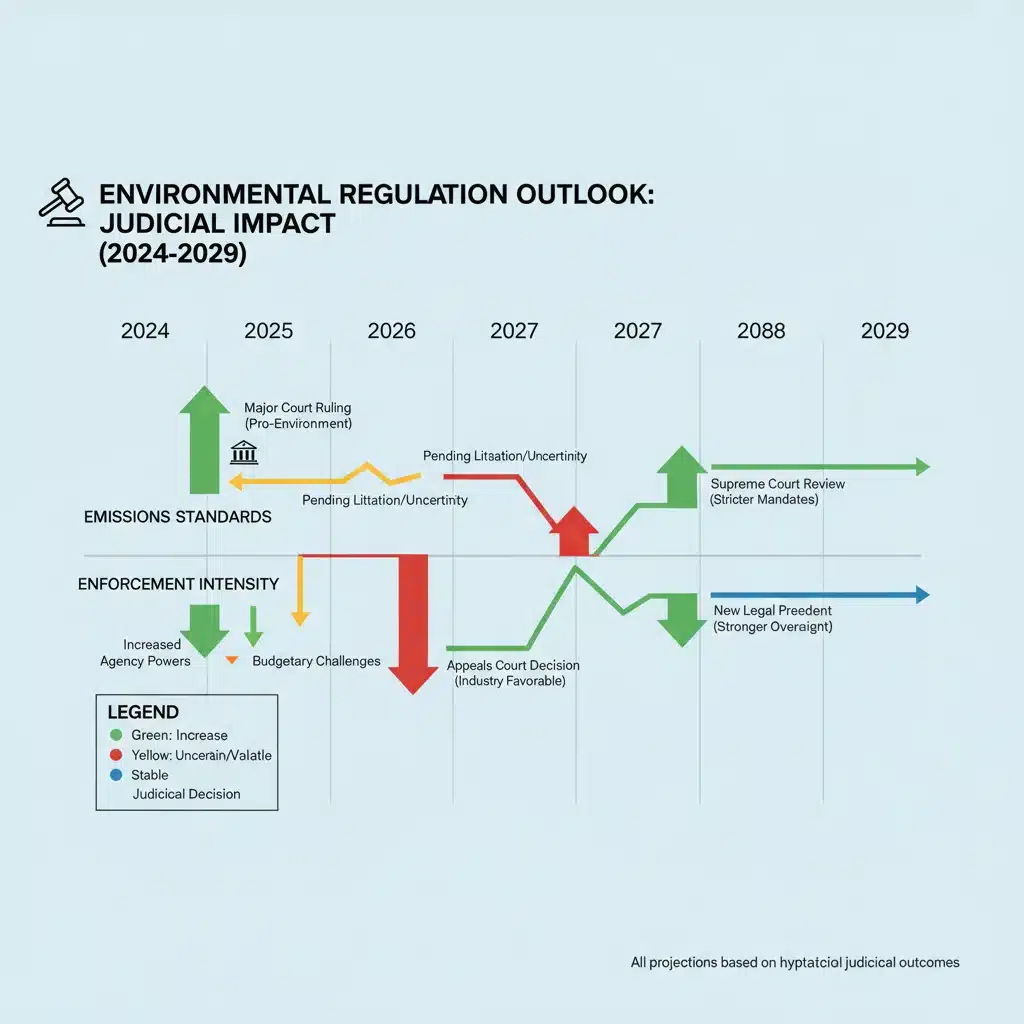
However, the Court did not entirely close the door on climate litigation. The rulings emphasized the need for clear, demonstrable harm and a direct causal link, suggesting that future cases with robust scientific evidence and narrowly tailored claims might still succeed. This puts a premium on advanced climate science and sophisticated legal strategies.
Impact on Key Industries Over the Next Five Years
The ripple effects of the 2026 Supreme Court environmental rulings will be felt across a spectrum of industries. Understanding these sector-specific impacts is vital for strategic planning and risk management.
Energy Sector
The energy sector stands to be among the most affected. With federal emission reduction mandates potentially weakened, traditional fossil fuel industries might experience a temporary reprieve from some regulatory pressures. However, this relief could be short-lived. The global push for decarbonization, coupled with state-level initiatives and investor demands for sustainable practices, will continue to drive the transition towards cleaner energy. Companies heavily invested in renewables and energy efficiency may find themselves in a more competitive position as market forces and state policies increasingly favor green technologies.
The uncertainty introduced by the rulings might also deter some long-term investments in large-scale energy projects, both fossil fuel and renewable, as companies await clarity on the future regulatory landscape at both federal and state levels. The next five years will see a significant re-evaluation of energy portfolios and investment strategies.
Manufacturing and Industrial Sectors
For manufacturing and other industrial sectors, the rulings concerning WOTUS and other pollution controls could mean a reduction in federal permitting requirements for activities near certain waterways or wetlands. While this might simplify some development processes, it also places a greater onus on companies to understand and comply with varying state and local regulations, which could be more stringent in some jurisdictions.
Companies with a national footprint will need to develop sophisticated compliance strategies that account for this regulatory patchwork. There’s also an increased risk of environmental justice concerns, as communities in states with weaker regulations may bear a disproportionate burden of industrial pollution.
Agriculture and Land Use
The agricultural sector, particularly regarding the WOTUS definition, could see significant changes. Farmers and landowners might have more flexibility in managing their lands without federal oversight of certain water features. While this is welcomed by some, it raises concerns among environmental groups about potential impacts on water quality, habitat loss, and the overall health of ecosystems that depend on these smaller water bodies. State-level initiatives around agricultural runoff and conservation practices will become even more critical.
Real Estate and Development
Developers may find it easier to obtain permits for projects in areas previously subject to federal wetland protections. This could accelerate development in some regions, but also increases the responsibility of developers to ensure their projects do not cause undue environmental harm, particularly where state regulations are less robust. Environmental impact assessments and due diligence will remain crucial, with a greater emphasis on local and state environmental review processes.
Navigating the New Regulatory Environment: Strategies for Stakeholders
In light of these 2026 Supreme Court environmental rulings, various stakeholders must adapt their strategies to thrive in the evolving environmental policy landscape.
For Businesses and Industries
- Enhanced State-Level Engagement: Companies must invest more in understanding and influencing state legislative and regulatory processes. Building relationships with state environmental agencies and local communities will be paramount.
- Robust Internal Environmental Programs: Even with reduced federal oversight, maintaining strong internal environmental management systems, setting ambitious sustainability goals, and pursuing voluntary certifications can enhance brand reputation, attract investors, and mitigate future regulatory risks.
- Legal and Compliance Review: Regular and thorough reviews of compliance strategies, particularly concerning multi-state operations, are essential to navigate the fragmented regulatory environment.
- Innovation and Investment in Green Technologies: The long-term trend towards sustainability remains. Investing in cleaner technologies and sustainable practices can provide a competitive edge and prepare companies for future shifts in policy, regardless of federal judicial interpretations.
For Policymakers and Government Agencies
- Strengthening State Environmental Capacity: States will need to bolster their environmental agencies with adequate funding, staffing, and technical expertise to effectively manage increased regulatory responsibilities.
- Interstate Cooperation: Addressing transboundary environmental issues (e.g., air and water pollution) will require greater collaboration and agreement among states.
- Clearer Congressional Mandates: Congress may need to consider drafting more explicit and detailed environmental legislation to provide federal agencies with the clear authority the Supreme Court now demands for significant regulatory actions.
- Public-Private Partnerships: Fostering partnerships with the private sector can help drive innovation and achieve environmental goals, especially where direct regulation is constrained.
For Environmental Advocates and Non-Profits
- Strategic Litigation: Advocates will need to refine their litigation strategies, focusing on cases that meet the Supreme Court’s increasingly stringent requirements for standing and causation, and exploring state-level legal avenues.
- Increased State and Local Advocacy: A greater emphasis on grassroots organizing, lobbying state legislatures, and engaging with local communities will be crucial for advancing environmental protection.
- Public Awareness and Education: Educating the public about environmental issues and the implications of reduced federal oversight can help build political will for stronger state-level protections.
- Promoting Market-Based Solutions: Advocating for policies that incentivize sustainable practices and disincentivize environmentally harmful activities through market mechanisms can be an effective approach in a less federally regulated environment.
The Global Context: International Repercussions
While the 2026 Supreme Court environmental rulings are domestic in nature, their effects can reverberate globally. A perceived weakening of U.S. federal environmental commitments could impact international climate negotiations and agreements. Other nations might view a less stringent U.S. regulatory environment as a signal to slow down their own environmental efforts, or conversely, it could spur them to take on greater leadership roles. The U.S.’s standing as an environmental leader could be questioned, potentially affecting trade relations and diplomatic efforts on global environmental challenges.
Multinational corporations operating in the U.S. will also need to reconcile their global sustainability commitments with the potentially diverging domestic regulatory landscape. Many companies have global environmental standards that exceed U.S. federal requirements, and these will likely continue to guide their operations, driven by investor pressure and corporate responsibility goals.
Conclusion: A New Era for Environmental Governance
The 2026 Supreme Court environmental rulings mark a significant inflection point in American environmental law and policy. They signal a clear trend towards a more circumscribed federal regulatory role and an enhanced, albeit more complex, role for individual states. Over the next five years, we will witness the unfolding of these decisions’ full impact, as states, industries, and environmental groups adapt to the new legal realities.
The challenges are substantial, particularly in ensuring a coherent and effective national approach to pressing environmental issues like climate change and water quality. However, opportunities also abound for innovation, state-level leadership, and a renewed focus on market-driven solutions and voluntary corporate responsibility. Navigating this new era will require vigilance, adaptability, and a collaborative spirit among all stakeholders to safeguard our environment for future generations.
The period between 2026 and 2031 will be a critical test of America’s commitment to environmental protection in a decentralized regulatory framework. The ultimate outcome will depend on how effectively states step up, how innovatively industries respond, and how persuasively advocates champion the cause of a sustainable future. The legal landscape has shifted, and with it, the strategies required to achieve environmental stewardship in the United States.