
Making Sense of Life Insurance for Families in 2026: Coverage Options and Cost Comparisons for $500,000 Policies
As we navigate the complexities of modern life, ensuring the financial well-being of our loved ones remains a paramount concern for many families. In 2026, the landscape of financial planning continues to evolve, making it more crucial than ever to understand the nuances of life insurance. For families, life insurance isn’t just another financial product; it’s a foundational pillar of protection, offering peace of mind and security against unforeseen circumstances. This comprehensive guide aims to demystify life insurance families need, specifically focusing on $500,000 policies, exploring various coverage options, and providing essential cost comparisons.
The decision to invest in life insurance is deeply personal, often driven by a desire to safeguard children’s education, cover mortgage payments, or ensure a spouse’s financial stability in the event of an untimely death. With numerous providers and policy types available, selecting the right plan can feel overwhelming. Our goal is to equip you with the knowledge to make informed decisions, ensuring your family’s future is protected, no matter what challenges lie ahead.
Why Life Insurance is Essential for Families in 2026
Life insurance serves as a critical safety net, providing a lump sum payment to your beneficiaries upon your passing. This death benefit can be used for a multitude of purposes, alleviating financial burdens during a difficult time. For families, the importance of this protection cannot be overstated. Consider the following scenarios:
- Income Replacement: If you are a primary or significant income earner, your death could severely impact your family’s ability to maintain their standard of living. Life insurance replaces this lost income.
- Debt Repayment: Mortgages, car loans, credit card debts, and other financial obligations don’t disappear when you do. A life insurance payout can cover these, preventing your family from inheriting financial strain.
- Education Costs: Planning for children’s college education is a significant financial undertaking. Life insurance can ensure these funds are available, regardless of your presence.
- Funeral and Burial Expenses: The immediate costs associated with a funeral can be substantial. Life insurance provides funds to cover these expenses, sparing your family additional stress.
- Future Financial Goals: Beyond immediate needs, life insurance can help your family achieve long-term financial goals, such as retirement for a surviving spouse or starting a business.
In 2026, economic uncertainties and the rising cost of living make these considerations even more pertinent. A robust life insurance policy is a proactive step towards securing your family’s financial future and providing invaluable peace of mind.
Understanding Different Types of Life Insurance for Families
Before diving into cost comparisons for a $500,000 policy, it’s crucial to understand the fundamental types of life insurance available. Each type offers distinct features, benefits, and suitability for different family needs and financial situations.
Term Life Insurance
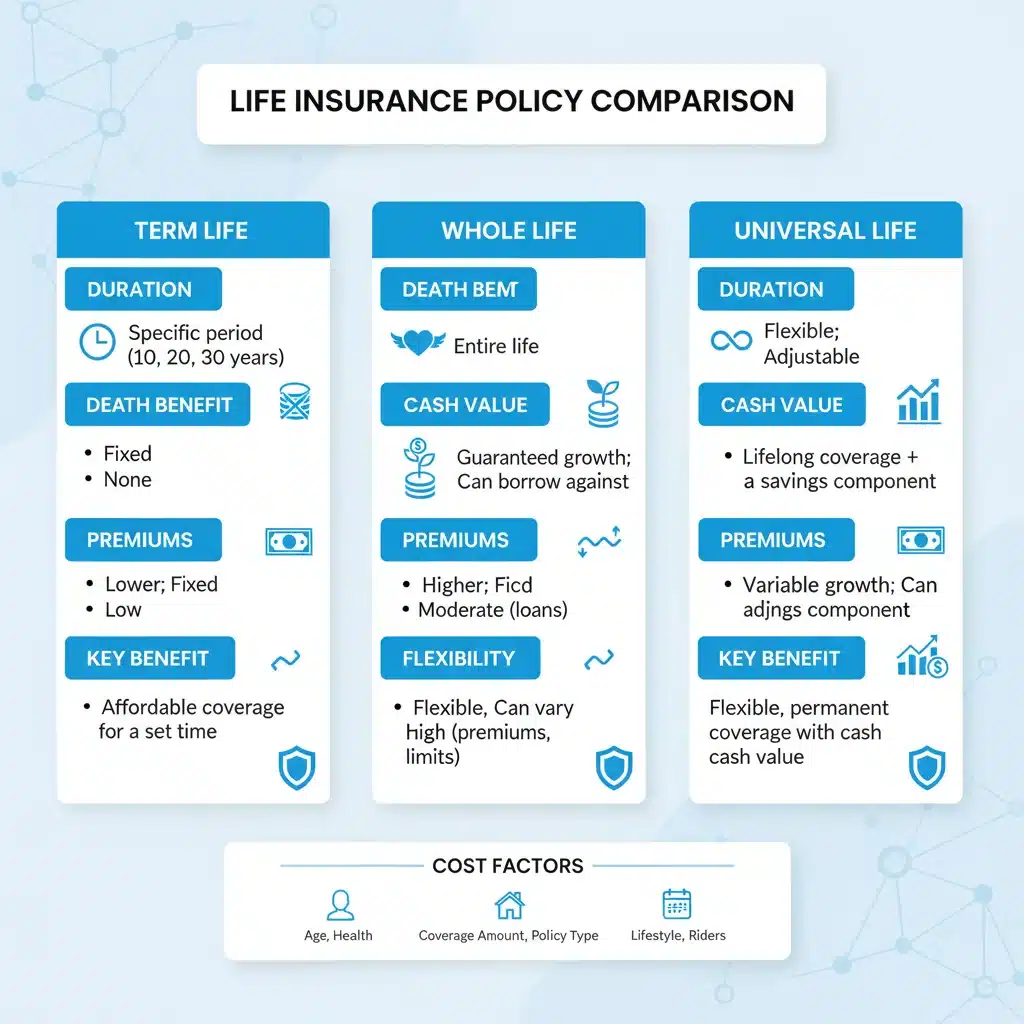
Term life insurance is often the simplest and most affordable option, especially for young families on a budget. It provides coverage for a specific period, or ‘term’ – typically 10, 20, or 30 years. If the insured passes away within this term, the beneficiaries receive the death benefit. If the term expires and the insured is still alive, the policy ends, and there’s no payout.
- Pros: Generally lower premiums, straightforward, ideal for covering specific financial obligations like a mortgage or children’s education during their dependent years.
- Cons: No cash value accumulation, coverage ends after the term unless renewed (often at a higher premium).
- Best for: Families who need substantial coverage for a defined period, typically while children are young or a mortgage is outstanding.
Whole Life Insurance
Whole life insurance is a type of permanent life insurance that provides coverage for your entire life, as long as premiums are paid. It also includes a cash value component that grows over time on a tax-deferred basis. This cash value can be borrowed against or withdrawn, though doing so can reduce the death benefit.
- Pros: Lifelong coverage, guaranteed death benefit, cash value growth, predictable premiums.
- Cons: Significantly higher premiums than term life, less flexibility.
- Best for: Families seeking lifelong coverage and a savings component, often as part of a broader estate planning strategy.
Universal Life Insurance
Universal life (UL) insurance is another form of permanent life insurance, offering more flexibility than whole life. Policyholders can often adjust premium payments and death benefits within certain limits. Like whole life, it also has a cash value component that grows tax-deferred.
- Pros: Flexible premiums and death benefits, cash value growth, lifelong coverage.
- Cons: More complex than term life, cash value growth can be sensitive to interest rate fluctuations, potential for higher fees.
- Best for: Families who desire lifelong coverage with the flexibility to adjust their policy as their financial needs change over time.
Other Permanent Life Insurance Options (Briefly)
- Variable Universal Life (VUL): Offers investment options within the cash value, allowing for potentially higher returns but also higher risk.
- Indexed Universal Life (IUL): Cash value growth is linked to a stock market index, offering upside potential with downside protection.
Understanding these distinctions is the first step in determining which type of life insurance families should consider for a $500,000 policy.
Determining Your $500,000 Life Insurance Needs
While this guide focuses on $500,000 policies, the optimal coverage amount for your family depends on several factors. A $500,000 policy is a common and often suitable starting point for many families, providing a substantial safety net. To determine if this amount is right for you, consider the following:
- Income Replacement: How many years of your income would your family need to replace? Multiply your annual income by the number of years. For example, if you earn $75,000 annually, a $500,000 policy covers about 6.6 years of income.
- Outstanding Debts: Sum up your mortgage balance, car loans, personal loans, and credit card debts. A $500,000 policy can often cover a significant portion, if not all, of these.
- Future Expenses: Factor in future costs like children’s college tuition (even if they are young, these costs can be estimated), childcare, and potential medical expenses.
- Final Expenses: Don’t forget funeral and burial costs, which can range from $7,000 to $10,000 or more.
- Spouse’s Needs: Consider if your surviving spouse would need funds for retirement, career changes, or other long-term financial goals.
A common rule of thumb is to aim for 5 to 10 times your annual income, but a more detailed assessment using the above points will give you a more accurate figure. A $500,000 policy is often a good balance between comprehensive coverage and affordability for many middle-income families.
Factors Influencing the Cost of a $500,000 Life Insurance Policy
The cost of a $500,000 life insurance policy can vary significantly based on a multitude of factors. Understanding these elements is key to finding the most affordable and suitable coverage for your family in 2026.
- Age: This is arguably the most significant factor. The younger and healthier you are when you purchase a policy, the lower your premiums will be. Life insurance rates increase with age because the risk of mortality increases.
- Health and Medical History: Insurers assess your current health status (e.g., blood pressure, cholesterol, weight), medical history (e.g., chronic conditions, past illnesses), and family medical history. A clean bill of health translates to lower premiums.
- Lifestyle: Your lifestyle choices play a crucial role. Smoking, excessive alcohol consumption, and engaging in high-risk hobbies (e.g., skydiving, scuba diving) can lead to higher premiums.
- Gender: Statistically, women tend to live longer than men, which often results in slightly lower life insurance premiums for females.
- Policy Type: As discussed, term life insurance is typically more affordable than whole life or universal life insurance for the same death benefit, due to its temporary nature and lack of a cash value component.
- Term Length (for Term Life): Longer term lengths (e.g., 30 years vs. 10 years) will generally have higher premiums, as the insurer is covering you for a longer period during which the risk of payout increases.
- Riders and Add-ons: Adding riders (e.g., critical illness rider, waiver of premium rider, accelerated death benefit rider) to your policy can enhance coverage but will also increase the overall premium.
- Insurance Company: Different insurers have different underwriting guidelines and pricing structures. Shopping around and comparing quotes from multiple providers is essential.
Being aware of these factors empowers you to take steps to potentially lower your premiums, such as improving your health or choosing a policy type that aligns with your budget and needs for life insurance families.
Cost Comparisons for a $500,000 Life Insurance Policy (2026 Estimates)
Providing exact quotes is impossible without personal details, but we can offer estimated monthly premiums for a $500,000 policy in 2026 based on general demographics. These figures are illustrative and can vary widely by insurer and individual circumstances. We’ll focus on healthy, non-smoking individuals.
Estimated Monthly Premiums for a $500,000 Term Life Policy (20-Year Term)
(These are general estimates for illustrative purposes and not guaranteed rates.)
- Age 30: $20 – $35 per month
- Age 40: $30 – $50 per month
- Age 50: $60 – $100 per month
As you can see, the cost steadily increases with age. A 20-year term is a popular choice for many families, often aligning with the period children are dependent or a mortgage is being paid off.
Estimated Monthly Premiums for a $500,000 Whole Life Policy
(These are general estimates for illustrative purposes and not guaranteed rates.)
- Age 30: $300 – $500+ per month
- Age 40: $450 – $700+ per month
- Age 50: $700 – $1000+ per month
Whole life premiums are significantly higher due to their lifelong coverage and cash value component. They are a long-term investment rather than purely a protection product.
Estimated Monthly Premiums for a $500,000 Universal Life Policy
(These are general estimates for illustrative purposes and not guaranteed rates.)
- Age 30: $150 – $300+ per month
- Age 40: $250 – $450+ per month
- Age 50: $400 – $700+ per month
Universal life premiums typically fall between term and whole life, offering a balance of permanent coverage and flexibility. The exact cost can depend heavily on the specific policy structure and rider choices.
Key Takeaway: The best way to get accurate pricing for life insurance families need is to obtain personalized quotes from multiple providers. Online comparison tools and independent insurance agents can be invaluable resources in this process.
Strategies for Finding Affordable Life Insurance for Families
Even with rising costs, securing an affordable $500,000 life insurance policy is achievable with the right strategy. Here are some tips:
- Buy Young and Healthy: As highlighted, age and health are primary cost drivers. Purchasing a policy when you are younger and in good health will lock in lower rates for the long term.
- Prioritize Term Life Insurance: If budget is a major concern, term life insurance offers the most coverage for the lowest premium. You can always convert it to a permanent policy later if your financial situation changes.
- Shop Around Extensively: Do not settle for the first quote you receive. Different insurers specialize in different demographics and risk profiles. Use online comparison sites and work with independent agents who can access multiple carriers.
- Improve Your Health: Quitting smoking, maintaining a healthy weight, and managing chronic conditions can significantly reduce your premiums. Insurers often offer better rates to individuals in excellent health.
- Consider Group Life Insurance: If available through your employer, group life insurance can be a cost-effective option, often requiring no medical exam. However, coverage limits might be lower, and it’s typically not portable if you leave the job.
- Bundle Policies: Some insurers offer discounts if you bundle life insurance with other policies like home or auto insurance.
- Review Your Needs Regularly: Your life insurance needs will change over time. Review your policy every few years, especially after major life events like marriage, childbirth, or a new mortgage, to ensure you’re not over- or under-insured.

The Application Process for Life Insurance in 2026
Applying for life insurance families need involves several steps. While the exact process can vary by insurer, here’s a general overview:
- Determine Your Coverage Needs: Use the guidelines above to estimate how much coverage your family requires. For this guide, we’re focusing on $500,000.
- Choose a Policy Type: Decide whether term, whole, or universal life insurance best fits your financial goals and budget.
- Gather Information: You’ll need personal details, financial information (income, debts), and extensive health history (doctors’ names, medications, family medical history).
- Get Quotes: Obtain quotes from several reputable insurance companies. Be honest and accurate with your information to receive realistic estimates.
- Complete the Application: Fill out the application form thoroughly. This is where you’ll disclose detailed health and lifestyle information.
- Medical Exam (for most policies): For most traditional life insurance policies, especially for a $500,000 death benefit, a medical exam will be required. This typically involves a paramedical professional taking your height, weight, blood pressure, and samples of blood and urine. Some ‘no-medical-exam’ policies exist, but they often come with higher premiums or lower coverage limits.
- Underwriting Process: The insurance company’s underwriters will review your application, medical exam results, and other records (e.g., MIB report, prescription drug history) to assess your risk profile and determine your final premium rate. This can take several weeks.
- Policy Approval and Acceptance: Once approved, you’ll receive the final policy offer with the exact premium. Review it carefully before accepting and making your first premium payment.
Being prepared with accurate information and understanding each step can streamline the application process for life insurance families require.
Common Riders and Add-ons for Family Life Insurance
Riders are optional provisions that can be added to a life insurance policy to enhance or customize coverage. While they increase premiums, they can provide valuable benefits for families.
- Waiver of Premium Rider: If you become totally disabled and unable to work, this rider waives your premium payments while keeping your policy in force.
- Accelerated Death Benefit Rider (Living Benefits Rider): Allows you to access a portion of your death benefit early if you are diagnosed with a terminal illness, critical illness, or chronic illness. This can be crucial for covering medical expenses or lost income during a difficult time.
- Child Rider: Provides a small amount of term life insurance coverage for your children, often convertible to a permanent policy later.
- Guaranteed Insurability Rider: Allows you to purchase additional coverage at specified future dates (e.g., after marriage, birth of a child) without undergoing another medical exam.
- Accidental Death Benefit Rider: Pays an additional death benefit if your death is caused by an accident.
Carefully consider which riders align with your family’s specific needs and provide the most value for the added cost.
The Role of Financial Advisors in Choosing Life Insurance for Families
Navigating the various life insurance options and understanding their implications can be complex. A qualified financial advisor or an independent insurance agent can be an invaluable resource, especially when considering life insurance families need for significant coverage like $500,000.
- Needs Analysis: An advisor can help you conduct a thorough needs analysis to determine the precise amount of coverage required, factoring in all your family’s unique circumstances.
- Policy Comparison: They can explain the pros and cons of different policy types and riders, helping you choose the most suitable option.
- Market Knowledge: Independent agents have access to policies from multiple insurance companies, allowing them to compare rates and find the most competitive options for your profile.
- Application Assistance: They can guide you through the application and underwriting process, ensuring all necessary information is provided accurately.
- Long-Term Planning: Life insurance is often part of a broader financial plan. An advisor can help integrate your policy with your overall estate planning, retirement goals, and investment strategies.
While online tools are helpful for initial research, a personalized consultation can provide tailored advice and ensure you make the best decision for your family’s future.
Common Misconceptions About Life Insurance for Families
Many families delay or avoid purchasing life insurance due to common misunderstandings. Let’s address a few:
- “It’s too expensive”: While permanent policies can be costly, affordable term life insurance options are available for most budgets, especially for younger individuals. The cost of not having it can be far greater.
- “I’m young and healthy, I don’t need it yet”: This is precisely the best time to buy! Premiums are lowest when you’re young and healthy, and you lock in those rates. Waiting can lead to higher costs or even uninsurability if health issues arise.
- “My employer’s group policy is enough”: Group policies are a good start, but they often offer limited coverage, may not be portable, and might not be sufficient to cover all your family’s needs. It’s often wise to supplement with an individual policy.
- “I have savings, so I don’t need insurance”: While savings are crucial, life insurance provides an immediate, substantial lump sum that most savings accounts wouldn’t be able to match quickly, especially in the early years of accumulation.
- “Only the primary breadwinner needs it”: Stay-at-home parents provide invaluable services (childcare, household management) that would be costly to replace. Their contribution should also be insured.
Dispelling these myths is vital for families to make informed decisions about their financial protection.
Conclusion: Securing Your Family’s Future with Life Insurance in 2026
In 2026, understanding and investing in life insurance remains one of the most responsible financial decisions a family can make. A $500,000 policy provides a significant layer of protection, capable of covering lost income, substantial debts, and future educational expenses. By understanding the different types of policies – term, whole, and universal life – and the factors that influence their costs, you can make an informed choice that aligns with your budget and long-term financial goals.
Remember to start early, shop around for quotes, and consider consulting with a financial professional to tailor a plan specifically for your family’s unique needs. The peace of mind that comes from knowing your loved ones are financially protected, even in your absence, is truly priceless. Take the proactive step today to secure your family’s future with the right life insurance families deserve.